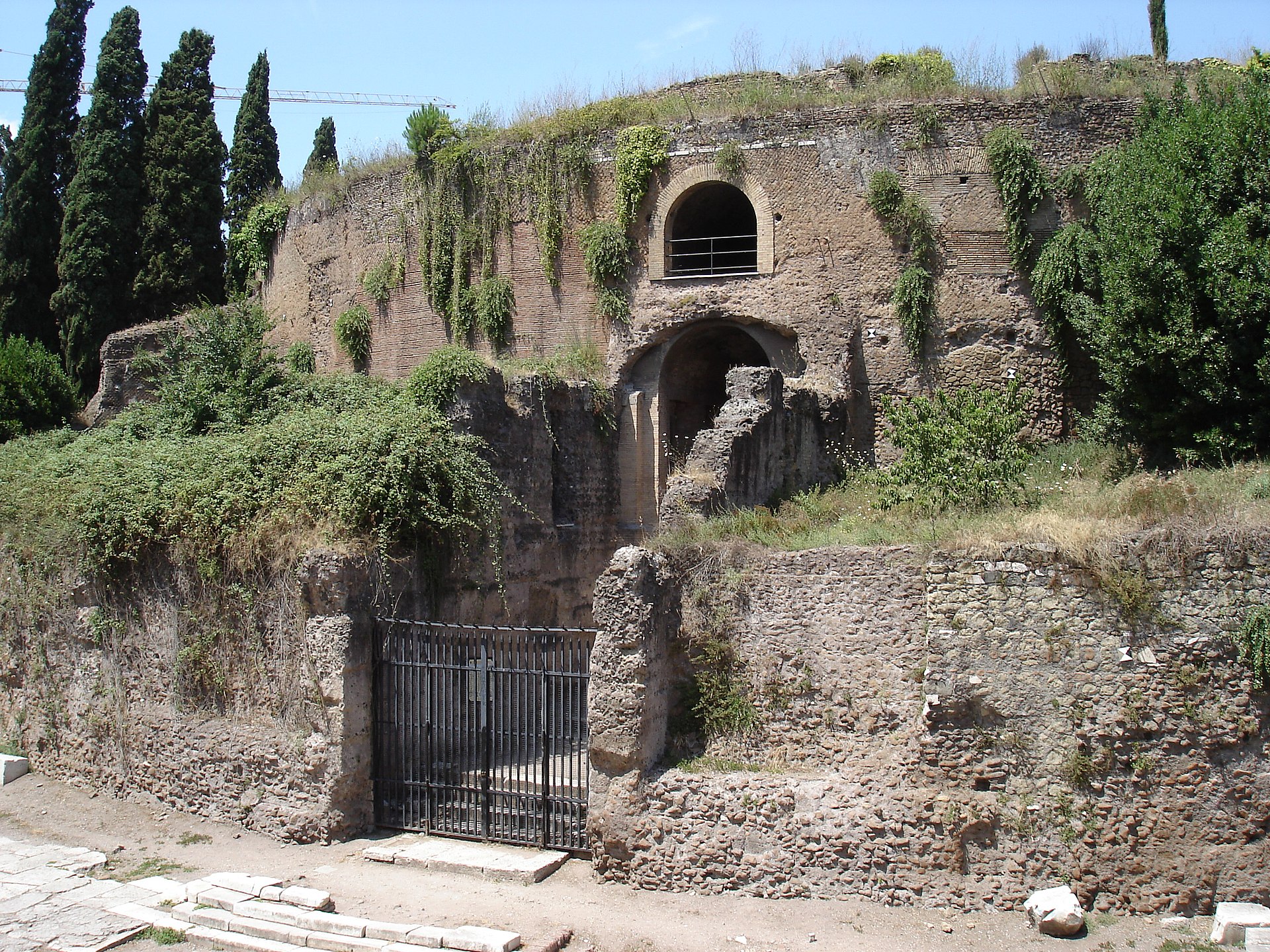
 About three hundred meters away from via del Corso, it turns left via della Ripetta pierced by Leo X to provide a straight road from the city center to the old river port. A little further is the Mausoleum of Augustus, the place of eternal rest of the emperor and his family, currently closed to the public and now only a quiet circle of cypress trees surrounded by paths and bushes. On the other side, between the mausoleum and the river, is in the Ara Pacis Augustae glass container (summer Tue-Sat. 9.00-13.30, wt., Wed. i sb. too 16.00-19.00, nd. 9.00-13.00; in winter, Tue-Sat. 9.00-13.30, nd. 9.00-13.00; 2000 L) that is "the altar of peace to Augustus", which is the more concrete and smaller remnant of the Roman era. It was built in 13 r. p. n. e. to celebrate Augustus' victory over Spain and Gaul and peace, which came as a result of this victory. The monument has been excavated piece by piece over the years, but most of it was found in the middle of the last century. Reassembling the monument was not an easy task: the excavation involved digging to the depth 10 meters and freezing of the aquifer, and many pieces of the monument had to be recovered from museums around the world. The monument is an outstanding example of a sculpture from the Roman Empire period; on an incomplete frieze, the best preserved on the eastern side, there are portraits of many famous characters; most of them were shown during the parade to celebrate the victory. The beginning of the scene was almost completely destroyed, but the figure of Augustus behaved a little better, as well as those who follow him: Tyberiusza, priests with skullcap headgear, and then Agrippa. The female characters are, appropriately, wife of August Livia, daughter Julia and niece Antonia, the latter in a realistic pose facing her husband. At their feet, children play, clinging to the seams of adult gowns, and the last child is said to be young Claudius.
At the end of via della Ripetta is the oval Piazza del Popolo, a magnificent square and road intersection, designed in 1814 r. by Valadier and representing a dignified - and very French - entry into the city: pure symmetry and great spaces. Outside of siesta time there is a free American car and people trying to get from place to place; in summer, steps around the obelisk and bars (for rich snobs) on the other side they are under siege. The real highlight of the square, however, is the unobstructed view along via del Corso of the entire center of Rome, all the way to the tasteless columns of the Victor Emmanuel Monument.
On the other side of the square, right outside the city walls, there is the church of Santa Maria del Popolo, with one of the best collections of Renaissance art of any Roman churches. The building was originally erected in 1099 r. over the burial place of Nero, to sanctify a place considered the habitat of evil, and then rebuilt in the 15th century. Inside the south nave there are frescoes by Pinturicchio and an apse designed by Bramante with two beautiful tombstones by Andrea Sansovino.
The penultimate chapel next to the northern aisle, Chiga chapel, was designed in 1516 r. by Raphael for Antonio Chigi, but most of the work was done by other artists; the chapel was not completed until the 17th century. Michelangelo's protege, Sebastiano del Piombo is the creator of the altar, and the sculptures of David and Habakkuk in the corner niches were made by Bernini. However, the most interesting two paintings by Caravaggio in the chapel on the left side of the northern transept. These are dramatic works in a style typical of the artist – Saul's conversion presents a future saint bathed in divine glow, but the horse is the main attraction, a Crucifixion of St.. Peter shows the martyr as old, but a sturdy man, a little bit lost among the muscular figures of bollards trying to pick up the cross. Just like the paintings by the same artist in the church of Santi Luigi dei Francesci, both works were considered extremely radical in their time, and the determined chiaroscuro and deliberate realism turned out to be unacceptable to the church authorities, which immediately rejected the images.