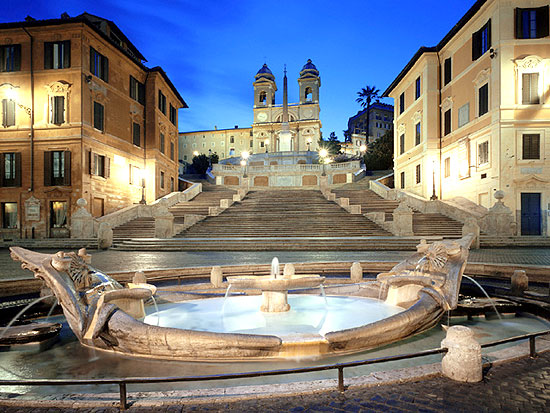
 Area immediately southeast of Piazza del Popolo, from the hills of the gardens of Villa Borghese to the Spanish Steps, this is the Rome of the newcomers, formerly an artistic district of the city. They came here in the 18th and 19th centuries. bedekerowcy in the search for color, exotic experiences, giving the area a uniquely cosmopolitan atmosphere. Keats and Giorgio de Chirico are just two of the characters, who lived in Piazza di Spagna, and Goethe was quartered on the nearby via Condotti, while Caffe Greco and Babington's Tea Rooms have been meeting places for local artists and expatriates for nearly two centuries. Today, these institutions are slowly giving way to more modern premises, where tourists are drowning dollars: McDonalds and American Express are making a loud presence in this area. Via Condotti and its adjoining streets are the hub of international fashion with some of the more expensive shops in Rome, and the inhabitants are classified as financiers rather than painters or poets. However, there are still many foreigners here, who discovered the charms of Rome, although they are more often businessmen on a business trip than people, that drop anchor here for a while.
Piazza di Spagna i okolice
Via del Babuino, which leads south of Piazza del Popolo, sets the tone for the neighborhood. In the 1960s, it was the core of a thriving artistic colony and the seat of the best galleries in the city, until high rents ousted most of the artists from here, except the most popular. At present, the trade in antiques is triumphant here. At the southern end of the street is Piazza di Spagna, long, chaotic, almost completely built-up square, with a boat-shaped Barcaccia fountain in the center, the last work of Father Bernini. The recently restored fountain commemorates the great Christmas flood 1598 r., when a barge flowing on the Tiber was thrown onto the slopes of a nearby hill. Pincio. On the southern edge of the square there is a column commemorating the official announcement by the nineteenth-century Pope Pius IX of the dogma of the Immaculate Conception - today this obelisk is even more controversial, because the decision of American Express, to spend on column renewal 200 L for each card used in Rome, met with a reluctant reaction from Protestant tourists. The McDonalds restaurant opposite had similar reactions a few years ago, this time on the part of the Romans, when the plan was announced to open the most ubiquitous fast food in the world in one of the most historic squares in Rome. The multinational has won and you can eat at McDonald's now, but it must be emphasized, that it is one of the most discreet branches of the chain, what you can imagine.
The Keats-Shelley House overlooks the plaza opposite the fountain (pn.-pt. 9.00-13.00 i 15.00-18.00; 3500 L), where the poet John Keats died in 1821 r.; now the house serves as an archive of literary and historical works in English and as a museum of manuscripts and literary memorabilia after Keats's circle from the end of the 18th century. - namely after Keats himself, po Mary Shelley i Byronie (who lived on the other side of the square at the same time). Among the many fragmentary manuscripts, of letters and the like is a silver clam shell reliquary containing the locks of Milton and Elizabeth Barret Browning's hair, while the death mask of the poet, kept in the room, in which he died, he portrays him with a resigned expression on his face. Keats did not feel well in Rome and described his stay here as "afterlife": he was haunted by his love for Fanny Browne, and for a few months before his death he was consumed with pains, he was unable to leave the station. He shared it with his artist friend Joseph Sevem, whom he confided in, that he "feels, how flowers grow on it ".
As for the Spanish Steps, which cascade down balustrades and balconies next to the house, all their Spanishness comes down to this, that their architect Alessandro Specchi is also the creator of the façade of the Embassy of Spain, to which the square and stairs owe their name. In the last century, young people were waiting on the stairs, that some artist passing by would take them for a model; today little has changed and the square serves as an international place for posing and picking up until late at night. Trinita dei Monti, A 16th-century church in fact at the top of the stairs, designed by Carlo Moderno and financed by the King of France, adds an international atmosphere to the square. Its rose Baroque façade reigns over the surrounding area from the hill. It's worth the climb because of the view. You can also go inside, to see some of the works by Daniel da Volterra, especially the delicate fresco of the Assumption in the third chapel on the right, on which there is a portrait of the artist's teacher, Michelangelo. The Entombment on the other side of the nave is also worth mentioning, though the lighting is not the best. Poussin considered this one, painted on the basis of a series of sketches by Michelangelo, painting for the third best in the history of painting (He put the Transfiguration of Raphael in the first place).