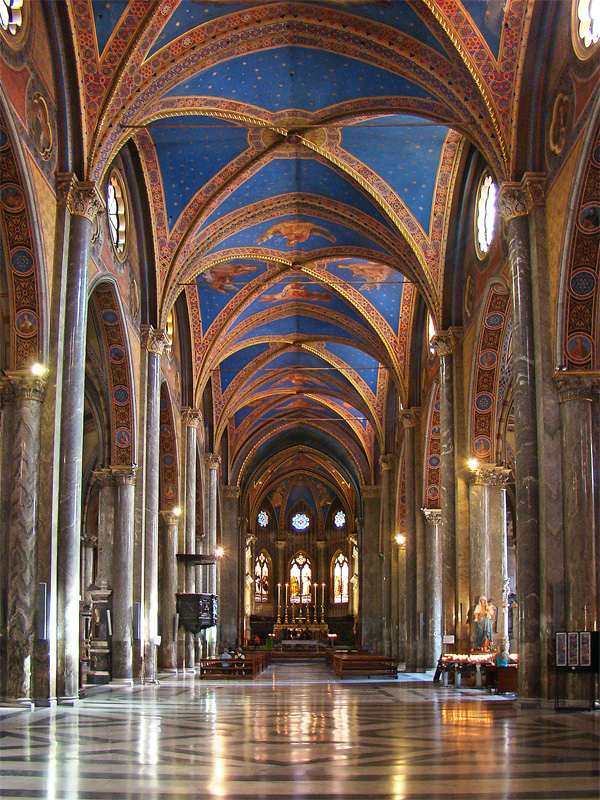
 Behind the Pantheon, further artistic delights in the form of Bernini's fountain, which, however, does not fully prepare for the splendors of the nearby church of Santa Maria sopra Minerva. The fountain is Bernini's most charming creation, though not the most typical: a joyful elephant blows a trumpet and carries an obelisk on his back - an allusion to the pontificate of Pope Alexander VII, to illustrate the fact, that intelligence should support wisdom. Santa Maria sopra Minerva is the only gothic church in Rome and it is worth visiting even for this reason, although the gothic lightness has been burdened with marble and frescoes over the centuries. The church was built in the 13th century. on the ruins of the temple of Minerva and is a treasury of art, with numerous tombstones and chapels funded by wealthy Roman families. The most famous of these is the Carafa Chapel in the southern transept, with an excellent fresco The Assumption by Filippino Lippi. Below is an image of the hopeful Carafa (the fanatical Pope Paul IV) presented to the Virgin Mary by Thomas Aquinas; another picture shows Thomas giving beans to heretics in front of two young boys - the future Medici popes Leo X and Clement VII of the Medici dynasty (in the background you can see the equestrian statue of Marcus Aurelius, then not on Capitol Hill). It is also worth looking at the figure of Christ carrying the cross, on the left side of the main altar, a work full of pride and serenity, completed in 1521 r. by Michelangelo especially for this church.
On the way to Piazza Navona, you pass the Church of Sant'Ivo, with an entrance from the Palazzo della Sapienza. Is it, at least from the outside, one of the most impressive churches in Rome, with a fun facade designed by Borromini. The church was built for the most famous of the popes from the Barberini family, Urban VIII. Each of the two small towers of the façade is crowned with almond-colored sculptural groups, and the middle dome has a crown of flames, which is to symbolize the Barberini family. However, it is difficult to get inside, you have to find a janitor.
The car-free Piazza Navona just behind the church is in many ways the central square of Rome. The almost completely enclosed, sausage-shaped space is surrounded by a garland of cafes and restaurants, and most of the year it is swarming with tourists, street artists and pigeons. Everyone gets here sooner or later during their stay in Rome. Political demonstrations are held here, and the restaurant prices are among the highest in the city; while in Tre Scalini on the west side you can eat delicious chocolate ice cream. It's best to come at night, when the tourist character of this place is most emphasized; people crowd around the fountains or inspect the square from the terrace of one of the bars with an expensive drink in hand. But also during the day there is a lot to see. The boundaries of the square are marked by the arena of Emperor Domitian, main object on the Field of Mars, where sports competitions and chariot races were held. The mossy ruins of the arena were here until the mid-15th century, but in the mid-17th century. Pope Inocenty X gave the square a new face by erecting sumptuous palaces and commissioning Borromini to design the Church of Sant'Agnese on the west side - although the church is not one of the most interesting in Rome, but certainly the most visited. legend says, that the completely naked Saint Agnes was thrown at the prey of the crowd in the stadium, then, by a miracle, she was able to cover herself with a coat of hair; this church, which Borromini, with his typical championship, fit into a breakneckly small space, is at the site of this legendary event.
Fontana dei Fiumi opposite, one of the three decorating the square, is the work of the archrival Borromini, Bernini. It is not a coincidence, that all characters cover their eyes in terror, in order not to see the church, Bernini was an arrogant man, who despised the works of the less successful Borromini. However, the fountain itself is a real work of art, and each figure is to represent one of the four great rivers of this world: Nil, Danube, Ganges and La Plata - although only the horse symbolizing the Danube was carved by Bernini himself. The obelisk brought here from Circus Maxentius by Innocent X towers over the magnificent stone group - hence the ancient Roman inscriptions.
Bernini also put his hand to the fountain on the southern edge of the square, designing the central figure "Moro", that is, Maura. Not far west of the square is the tiny Piazza Pasquino, which is a bit disappointing after centuries of satirical creativity on the subject, but in the corner stands a bust of Pasquino himself, an anonymous medieval mocker of the rich and famous. It is the most famous of the so-called "talking statues" in Rome, to which anonymous comments on current topics are attached, whose intention is so comical, what's serious. Pasquino gave the Italian language the word "pasquinada" (lampoon), which, however, has not been in widespread use in the last hundred years. During the unification period, the statue was given the initials S.. P. Q. R. - Holy Father Once a King, or "Holy Father, formerly King". Bernini described the statue as "the most beautiful ancient sculpture in Rome", though it is so battered, it's hard to guess, what the master meant.
Behind the square are some of the most lively streets in Rome, noisy at night and built up with very popular restaurants and bars. After a short stroll via dei Coronari, where many Roman antiquities dealers were located, head back to the northern end of Piazza Navona (here, behind the glass in the foyer of one of the buildings, there are the only preserved fragments of Domitian's arena). Further on, you will see the Renaissance façade of the Church of Sant'Agostino occupying one part of the dingy square of the same name: nothing special from the outside, but inside there are some important works of art, m.in. full of vitality Isaiah Raphael on the third pillar on the left, carded Saint Anna Samotrzec Sansovina and, in the first chapel on the left, Madonna i pielgrzymi Caravaggia; though it's so dark there, that it's probably better to buy a reproduction postcard. More works by Caravaggio can be found on via della Scrofa in the French national church of San Luigi dei Francesi (codz. 7.30-12.30 i 15.30-19.00; 200 L for the illumination of images), in the last chapel on the left. There are early works on the life and martyrdom of Saint Matthew, the best of which is The Calling of Saint Matthew on the left wall - Matthew is an impressionable young man on the left, illuminated by a shaft of sunlight. These paintings were Caravaggio's first public commission and were initially rejected, partly because of indecency. The artist had to make significant retouching, before they were adopted.
From the church, you can walk via Piazza della Rotonda to Piazza Montecitorio and Palazzo di Montecitorio, from 1871 r. the headquarters of the Italian parliament, the building itself is another work of Bernini. The obelisk in the middle of the square was brought to Rome by Emperor Augustus and set up on the Field of Mars, where it was the hand of a giant sundial. The official seat of the prime minister is right next to it, Palazzo Chigi, which closes Piazza Colonna from the north. Marcus Aurelius Column, to which the square owes its name, has recently been unveiled after renovation, and it was built between 180-190 n. e. to commemorate military victories in northern Europe and decorated with reliefs depicting scenes from military campaigns. Stairs lead to the top of the column, but you must obtain permission to enter.