 West of Piazza Venezia
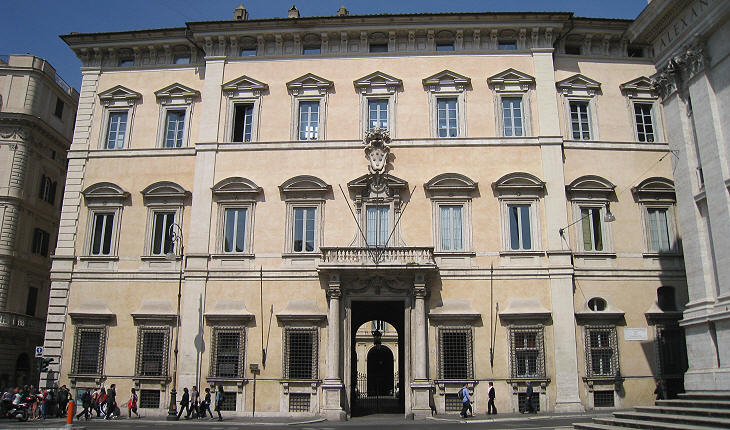
Via del Plebiscito to the west of Piazza Venezia is dark, quite a gloomy thoroughfare with constant congestion. About 300 m further, on the north side of Piazza dei Gesu, stands the dark-gray decaying huge edifice of Palazzo Altieri. In its time it was tried, that, as in the case of the Golden House of Nero, half of the city will have to be demolished for its construction. However, the Pope of the Altieri family, In an act of mercy, Clement X incorporated an old woman's house into the palace, who refused to move; there were three barrels left of this house just above the ground-floor windows, three rows to the left of the entrance.
Right above the square (on which, by the way, there are reportedly the greatest drafts in all of Rome) II Gesu reigns (codz. 6.00-12.30 i 16.00-19.30), baroque church typical of the Counter-Reformation and the Jesuit Order: high, wide, one-aisle, with a huge dome at the intersection of the nave with the transept, ideal for large ones, excited crowds, that the Jesuits wanted to attract. This building served as a model for Jesuit churches throughout Europe. The creator of the facade was Giacomo della Porta, and the interior of Vignola. Today, many believers still come here. The church is famous for its sheer size (in the eastern part of the transept, the largest stone block in the world) and richness of decor (the word "glamor" would be a euphemism) with paintings by Baciccia on the dome and a clever illusionist plafond with a tangle of bodies, which seem to pop out of the frame; undulating drapery and stucco angels that look like bats.
Farther west, Corso Vittorio Emanuele overlooks Largo di Torre Argentina, a large square with insane traffic circling around four republic-era temples, now inhabited by cats and closed to the public. There isn't much to see here, but on the other side of the square is Teatro Argentina, where in 1816 r. the premiere of Rossini's Barber of Seville took place - on the first evening the artist was booed and had to take refuge in the neighboring Bemasconi's confectionery. In the built in 1731 r. the theater still performs most of the opera performances in Rome.