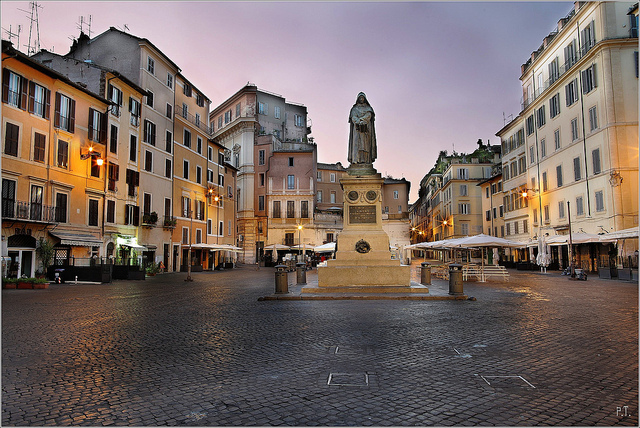
 Campo dei Fiori i okolice
From Largo Argentina you can either continue on Corso Vittorio Emanuele or turn left towards the Tiber or right towards Piazza Cairoli and the street grid around Campo dei Fiori. If you choose Corso, you pass the Church of Sant ’Andrea del Valle, which boasts the tallest dome in the city (after St.. Peter), built by Carlo Moderno. A little further on the left is the Piccola Famesin Palace, built by Antonio Sangallo the Younger and housing the Museo Barracco (temporarily closed), with minor ones, but of good quality, collections of ancient sculpture, which were donated to the city by a certain Baron Barracco. The palace itself never had anything to do with the Famese family; the name is derived from the lily on the outside, which were taken as the heraldic lilies of the family. There is one more museum, Museum of Rome, located in the 18th-century Palazzo Braschi on the other side, exhibiting exhibits related to the history of the city from the Middle Ages to the present day. There you can see paintings depicting Rome in different eras, frescoes from demolished palaces and an open railway carriage, which Pope Pius IX used in the 19th century. to travel outside the city. And this museum, however, is currently closed for renovation.
The Palazzo di Cancelleria is also located on the same square, was the seat of the papal government, who once administered the city. The back streets lead chaotically to Piazza di Campo dei Fiori, in many ways the most attractive square in Rome, where fruits and vegetables are sold in the morning, and numerous restaurants and cafes are almost constantly filled. Nobody really knows, where did the name of the square come from "flower field". According to one theory, the name comes from the Roman Campo Martius, which covered most of this part of the city; another says, that the name was given by Flora, the harlot of Pompeii, whose theater was located on the present north-eastern edge of the square - in this enormous building Julius Caesar was killed by Brutus (the foundations of the theater can still be seen in the cellar of the Da Pancrazio restaurant in the tiny Piazza del Biscione). Later, the square was an important point on the route of papal processions between the Vatican and the main basilicas in Rome (especially St.. John in Lateran) and the place of public executions. A memento of the most infamous of them is the statue of Giordano Bruno in the middle of the square. Bruno was a rationalist from the end of the 16th century., who promoted the teachings of Copernicus and was denounced to the inquisition; his trial lasted for many years under successive popes and eventually, when the scientist refused to disavow his philosophical views, he was burned at the stake.
Just south of Campo is the completely different Piazza Famese, with huge plate-shaped fountains brought from the Baths of Caracalla and the stately building of Palazzo Farnese itself (currently the French embassy). Its construction was initiated by 1514 r. Antonio di Sangallo the Younger, and finished after the architect's death, Michelangelo, creator of the top row of windows and cornice. Unfortunately, it is impossible to get there, and the building houses one of the most beautiful plafonds, The love of the Caracci gods, completed in 1600 r. It is therefore necessary to be pleased with Palazzo Spada, towards via Arenula, with the Falling Gallery inside (codz. 9.00-14.00; 2000 L; guided tour in Italian Sat. 11.00), although its four rooms, decorated in the style of the house of a Roman noble family, they will rather interest only connoisseurs of 17th and 18th century Italian painting. The best pair of portraits by Guido Reni are, works by some Dutch artists influenced by Italian (from Scoreli, Honthorst) and the seated philosopher standing out among various Roman statues. The building itself is more interesting: the facade is decorated with fun stucco motifs, and to the left of the courtyard there is Borromini's clever trompe l'oeil - a tunnel that looks four times longer than it actually is thanks to the trick with perspective.
Behind the palaces of Famese and Spada runs parallel to the Tiber via Giulia, built by Julius II, to connect Ponte Sisto with the Vatican. The street was conceived as the center of papal Rome. At the request of the Pope, Bramante was to build it with a row of impressive palaces. The project didn't go too far, when Leo X took the papal throne, but via Giulia has become a fashionable residential street of wealthier Roman families and still has chic buildings.