 South of Piazza di Spagna
From the church you can walk either left past the French Embassy to the Pincio terrace and Villa Borghese gardens or south along via Sistina to Piazza Barberini, a busy intersection at the end of the via del Tritone shopping street. Its name comes from Fontane del Tritone, shooting a high stream of water in the middle of the square. The fountain gives the square coherence in several respects: traditionally it was the Barberini district, the patronage of G.L. Bernini, whose works in their honor are a common sight here. The Triton Fountain was completed by the sculptor of St. 1644 r. and shortly thereafter designed the Fontane delle Api (The Bee Fountain) at the end of via Veneto. Contrary to the Triton Fountain, it is a small and modest object - a swarm of bees rests on a wide shell, which were the emblem of the Barberini.
The Capuchin Church of the Immaculate Conception a little further on via Veneto is another facility funded by the Barberini. The building itself does not stand out with anything special, but inside is Saint Michael trampling on Satan by Guido Reni. Innocent X is considered to be the prototype of Satan, whom the artist despised and who was the sworn enemy of the Barberini family. Whereas the Capuchin cemetery (codz. 9.00-12.00 i 15.00-18.30) to the right of the church is one of the most macabre and bizarre monuments in Rome. The walls of a number of chapels are covered with bones 4000 monks. This monument to "our sister, mortal death ", speaking in the words of St.. Francis, was built in 1793 r. The bones were placed on the walls in abstract patterns or as fully clothed skeletons, with faces protruding from their hoods with a grimace of agony - the thing is somewhere between horror and farce.
Sama via Veneto, which turns north here and leads all the way to the southern end of the Borghese Gardens is cynical, a materialistic antidote to the dark atmosphere of the Capuchin Grotto. Golden Roman youth once immortalized in its exclusive bars and restaurants by Fellini in Dolce Vita, but nowadays expensive trash dominates the street. There is also the fortified building of the US Embassy. Today Anita Ekberg's leg wouldn't stand here, and self-respecting snobs now flock to Piazza del Popolo, so it is better to go back to Piazza Barberini and head along via delle Quatro Fontane. At the via Rasella on the right, the 1944 r. ambushes on a German military patrol, as a result one of the greatest atrocities committed in Italy during the war took place: in the catacombs outside the city, they were murdered in retaliation 300 Romans. The bullet holes in the house on the corner of via Boccaccio remain a kind of monument. By a tasteless coincidence, Mussolini had an apartment on Via Rasella, in which he welcomed his mistresses.
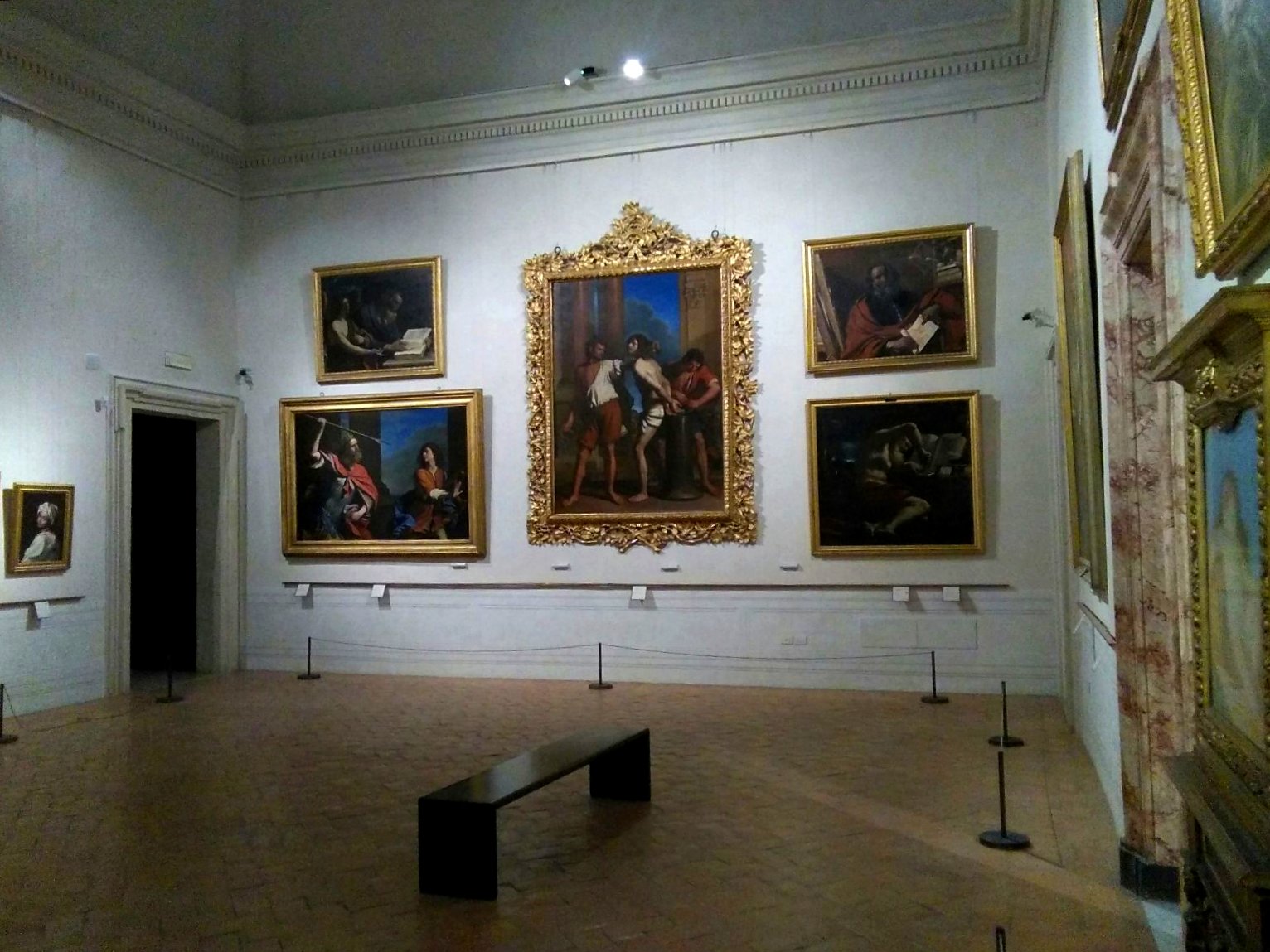
Across the road in Palazzo Barberini is Galeria di Arte Antica (wt.-sb.9.00-14.00, nd. 9.00-13.00; 3000 L), where a rich mixture of art is displayed in the rooms of the palace adapted for this purpose, mainly Italian from the early Renaissance to the late Baroque. Except for Tintoretto's canvases, Tycjana and El Greco, the biggest attraction is the painting Madonna and Child by Fra Filippo Lippi, full of maternal warmth, painted in 1437 r., where for the first time in Italian religious art there is a background detail in the form of architecture, and the charming Fornarin Raphael, which some experts attribute to the master's apprentice, though his name appears on the woman's bracelet. The most beautiful, however, is probably the gallery building itself, which is the embodiment of baroque splendor. The most popular architects of their era worked on it at different times: Bernini, Borromini, Demos. Salone was undoubtedly supposed to make the greatest impression, and the plafond fresco, The Floor of Cortona, is one of the best examples of dynamic Baroque illusionism: the obsessive Triumph of Divine Providence almost seems to creep up the walls to meet the spectator.
Continuing along via delle Quarto Fontane, you come to another famous monument from the 17th century, church of San Carlo alle Quattro Fontane (codz. 10.00-12.30). It was Borromini's first commission. In it he shows all his brilliance, which he later became famous for, subtly forcing the church into a plot of inconsistent shape and an area equal to the cross-section of one column of St.. Peter. Four fountains in front of the building, to whom the church and street owe their name, are located at the four corners of the intersection being the highest point on the Quirinal River. After a while it comes to naked, the unadorned wall of the Palazzo Quirinale, 16th-century building, which until reunification served as the official residence of the popes, and then it was renamed the royal palace. Currently, it is the seat of the President of Italy, which is closed to the public, but from the Piazza del Quirinale on the other right, you can admire the unique location of the palace, as well as a view of the center of Rome.
Below, amidst a dense grid of narrow ones, streets seemingly going nowhere, is one of the most surprising monuments in rome, on which it is easy to stumble upon unexpectedly - Fontane di Trevi, a great baroque cascade of water over the statues and stones at the rear of the Renaissance palace. The water comes from the same source, what in the fountain works of Baraccia in Piazza di Spagna. The Trevi Fountain was previously around the corner via dei Crocifieri, much smaller and more modest, but Urban VIII decided to meet the demands of the times and hired Bernini, to design a more magnificent fountain. The construction was started only by Niccolo Salvi in 1723 r., but then it took a while to complete the project 39 lat. Salvi had already died during this time, after catching a cold lungs in the humid environment of the fountain's sewage system.
You need to put a coin in the Trevi Fountain, if you want to go back to Rome (although Anita Ekberg in Dolce Vita jumped all over). There is a lot of traffic here in the evening. On the other side is the scruffy parish church of the Quirinale Palace, Sand Vicenzo ed Anastasio, where by some strange coincidence they "reside” marble urns with hearts and guts 22 popes, who lived in the palace. A bit of the way to the south is the Colonna Gallery. via del Pilota 17 (only Sat. 9.00-13.00; 5000 L), member of the Palazzo Colonna band. Although many Roman palaces have better collections, it is worth sacrificing for example 40 minutes even because of the Great Hall with chandeliers, in which most of the paintings are exhibited. The best part of the gallery is Dughet's collection of landscapes (Poussin's brother-in-law), and other outstanding works include the early - and surprisingly spontaneous - Bean Eater by one of the Caracci brothers (though the authorship is disputed), Tintoretto's Narcissus and Portrait of a Venetian Captured in an Extremely Confident Pose by Paola Veronese.