 Colosseum, Celius and east to St.. John in Lateran
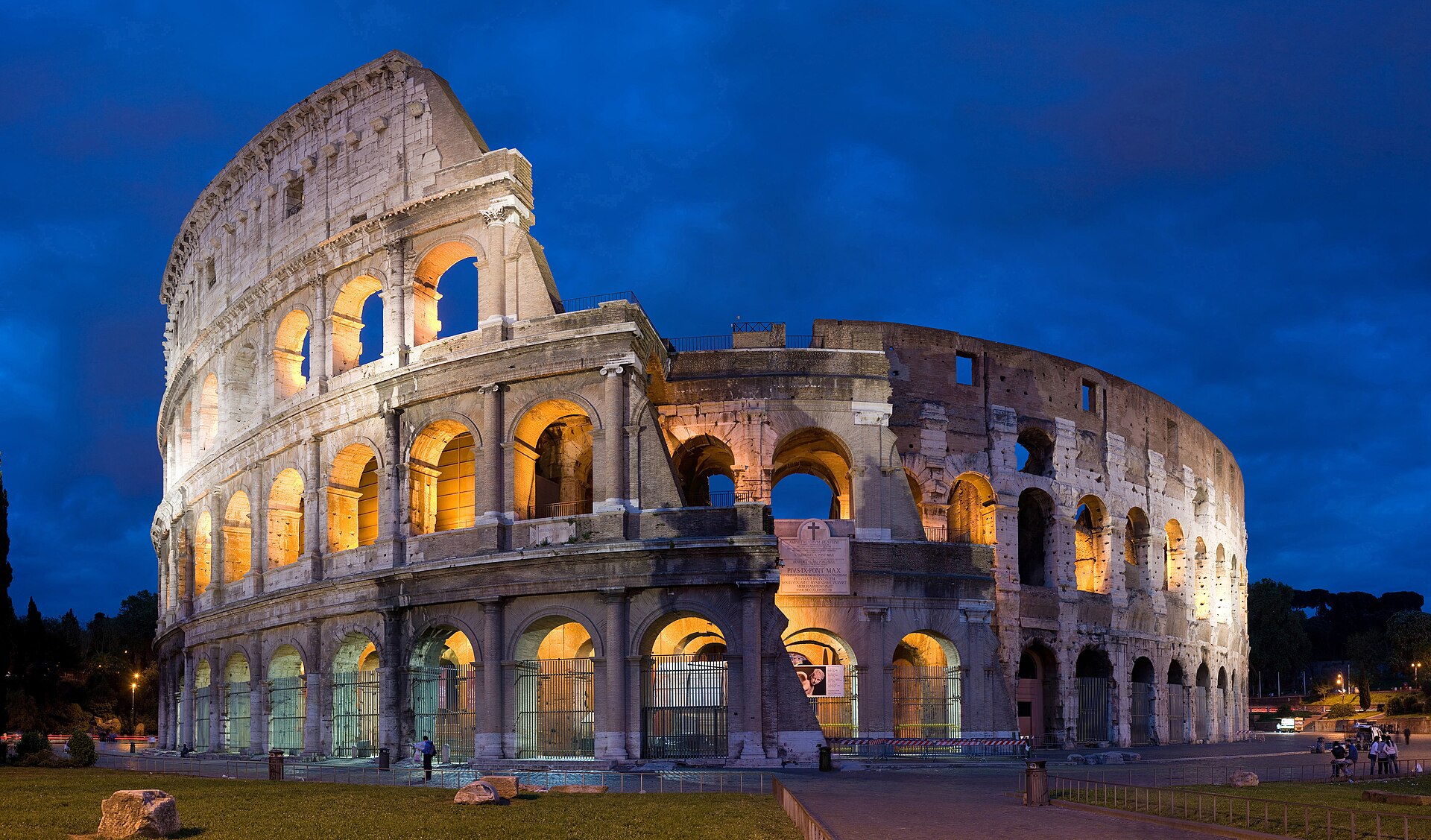
Constantine Arch from the 4th century. just behind the Forum, it marks the end of Via Sacra; internal friezes have been looted from others, earlier monuments. On the other side of the road is the Colosseum (pn., wt. and Thu-Sat. 9.00-19.00, nd. and Wed. 9.00-13.00; Free entrance), undoubtedly the most impressive ancient monument in Rome, which - unlike the Forum - does not require any particular imagination and historical knowledge, to visualize its function. It was originally called the Flavian Amphitheater, and the construction was started by Emperor Vespasian around. 72 r. n.e., his son, Titus, graduated some eight years later - this event was celebrated on-going 100 days of uninterrupted games. The Romans flocked here on numerous occasions: Gladiator fights were very popular, whose aim was to prepare soldiers for real warfare. There were also others, cruel performances: man was against the beast, or the beast against the beast; even fake sea battles were organized, as flooding the arena with water was a matter of minutes. The common denominator was violence: slaughter, especially on animals, it was extremely bloody and led to the extinction of entire African species; and although gladiators earned a lot of money - and enjoyed the status of stars - skirmishes often ended in death.
W V w. this kind of entertainment was forbidden in and out of the Colosseum, which for years was raking stone for building material for the largest palaces in Rome (the stone from this place can be found in the Barberini and Cancellaria palaces, and even St.. Peter) only the shell remained. The arena floor was completely gone, revealing a maze of tunnels underneath, with which the animals were brought; initially there were statues in the outer arcades, and in places, where huge blocks of stone were connected with metal corbels, there are holes gaping now. However, the basic structure of the building is clear and has served as a model for stadiums around the world. It is not a secluded place, and in the summer, the mixture of crowd and scaffolding causes, that a tour of the Colosseum is more like a construction site than an ancient monument. But in the evening or early morning, before the coaches arrive, it makes sense to climb somewhere upstairs, and the arena will seem a miracle rather than a reality.
The animals used in the Colosseum were kept in a zoo just outside the arena on Celius Hill, the southernmost point of the seven hills of Rome; probably the most secluded, almost completely forested, with a wonderful park around Villa Celimontana in the heart. You can get there by entering Piazza di Navicella, a bit from via Claudia, and it is a real pleasure to walk up the hill. If you are in a rush, then walk down Clivo di Scauro from the square at the edge of the park to the top of the hill, where the Church of Santi Giovanni e Paolo is located in a quiet square surrounded by a dense series of medieval facades (codz. 8.00-12.00 i 15.30-17.30) with a picturesque campanile. The original founder of the church was the Roman senator Pammachius. It is, in a sense, a monument to people, who refuse to perform military service for moral reasons, because the church is dedicated to two dignitaries at the court of Constantine, who were beheaded here in 361 r., for they did not want to go to the army. The remains of their home are downstairs (key at the sacristan)—A total of about twenty rooms, with frescoes depicting pagan and Christian motifs - and a fenced-off square in the middle of the nave marks the place, where they were martyred.
From the church, the road descends under more brick arches to the church of San Gregorio Magno on the left, reigning over the busy street and facing the soaring pines on the opposite Palatine. And this time it is the most interesting, associated with the church, legend. Gregory the Great sent from here at the beginning of the 7th century. Augustine, to convert England to Christianity, and although in the fairly common baroque interior there are few souvenirs similar to this event, in one of the side chapels there is a beautifully carved altar with the life of St.. Gregory. There is also a hall with its marble throne.
After returning to the Colosseum, along Saint John Lateran Street, you will come to the San Clemente Light Church, white 12th-century basilica, which perhaps best embodies the continuity of the city's history. It is in fact a conglomerate of three sacred buildings. The above-ground part is an excellent example of a medieval basilica: the old-fashioned facade and courtyard are oriented to the east, and in the apse there are beautiful ones, mosaics full of warmth. Below (codz. 9.00-12.30 i 15.30-18.30; 1000 L) there is the nave of an earlier church dated to 392 r. n.e., with a narthex covered with frescoes depicting, among others. Miracle of St.. Clement, one of the first popes, consecrated, as it was believed, by St.. Peter. However, in the eastern part of the church there are remains of a Roman house - lots of rooms, including a damp temple from the end of the 2nd century. with the altar of the ancient Iranian god Mithra.
Finally, the same street leads to the Basilica of St.. John in Lateran (San Giovanni in Laterano), the official cathedral of Rome and until the reunification of Italy, seats of popes. After 1870 r. the popes took refuge in the Vatican, until the Lateran system with 1929 r. he did not grant this and other papal basilicas the status of extraterritoriality. From the 4th c. there was always a church standing in this place, first founded by Constantine. Current construction, rebuilt by Borromini in the 17th century, similarly to San Clemente testifies to the extraordinary richness of Roman history and contains elements from various periods of its history. What a strange thing, the church door is from the Curia, that is, the Senate House, next to the Roman Forum. There is a fragment of a fresco by Giotto on the first pillar on the left in the right aisle, depicting Boniface VIII proclaiming the year 1300 a holy year. Further on, a slightly newer monument is a tribute to Sylvester I., "Pope - wizard", Bishop of Rome for most of the reign of Constantine. Part of the original New Year's Eve tomb was incorporated into the monument, where the rumble of bones is coming from, when the Pope is to die. Behind the papal altar are the heads of St.. Peter and Paul, the most important relics in the church. The cloisters are the most pleasant part of the complex (1000 L) decorated with 13th-century cosmatesco mosaics and chaotically arranged details from the original basilica. In one of the side rooms there is a papal throne and various papal memorabilia (m. in. pontifical vestments of Boniface VIII).
The Lateran Palace is adjacent to the basilica, seat of the popes in the Middle Ages and formally also part of the Vatican. The adjacent baptistery is the oldest surviving building of this type in the world. This octagonal structure was erected in the 5th century. and was a model for many such structures. On the other side of the church, na Piazza di Porta San Giovanni, there are more old ruins, among which the Scala Santa stands out, passing as the stairs of the house of Pontius Pilate, after which Christ descended after the trial. 28 the steps are boarded for protection and may only be entered on the knees, what pilgrims regularly do. At the top of the stairs is the chapel of San Lorenzo with an antique (6th-7th centuries) a painting of Christ. This image was to be made by an angel and hence its name - archeiropoiette, or "not a creation of a human hand".
Porta San Giovanni across the square is part of the Aurelian Walls and one of the city's grandest gates. Walking from the inside along the wall along viale Carlo Felice, you come to another magnificent church in Rome, Holy Cross in Jerusalem, one of the seven pilgrim churches in the city. It was built on the site of the palace of Constantine's mother, st. Helena, to house the relics of the Cross of Christ, which she brought from Jerusalem. As a result of the 18th-century renovation, the building has a mainly Baroque interior, while the relics of the Cross are kept in the chapel at the end of the left aisle. Depicting the discovery of the fragments of the Cross, the Renaissance mosaics in the apse are truly unique. North of the church towards the railroad tracks is Porta Maggiore, probably the most impressive of the gates in the city, built in the 1st century. n.e. to bring water to Rome from the aqueducts outside.