 South of Piazza Venezia
Via dei Fori Imperiali leading from Piazza Venezia to the most interesting ancient monuments is a somewhat soulless boulevard established in 1932 r. by Mus-solini. Previously, there was a tangle of medieval streets winding around the ruins of the ancient city center, but - as in the case of via della Concillazione, Duce preferred to build something for his own glory rather than to keep an inheritance from another era. It was planned to establish a huge architectural park reaching as far as the catacombs at via Appia Antica, but the idea was never realized; the project was recalled a few years ago, but without much conviction, and for the time being, most of the ancient city remains hidden under the road surface.
Via dei Fori Imperiali is sometimes used for military parades, and provides a good connection between the Colosseum and Piazza Venezia. Most of the hikers, you can meet here, are tourists exploring the ancient monuments. The most important of them is the main part of the Roman Forum, and then the Palatine Hill and of course the Colosseum, all to the right of the street. In addition, on both sides of the via dei Fori Imperiali, there are remains of various squares of ancient Rome, built in the dusk years of the republic, when the actual forum grew too small for the needs of an ever-expanding city.
The Trajan Forum on the left side of the street was the victim of the reconstruction carried out by Mussolini, in its time one of the most impressive imperial squares, now almost beyond recognition. The Forum turned into a square with a group of columns sunk into the ground, lying in front of the semicircle of Trajan's market halls. It was a multi-story ancient trading house, which can now be entered from via IV Novembre and where temporary exhibitions are held. Behind it is the better preserved Torre delle Milizie, from which Nero was to watch the fire of Rome, but the most famous and best-preserved monument is the Trajan's Column closer to Piazza Venezia. It was erected to commemorate the colonization by the emperor of Dacia (today Romania). It is now carefully wrapped and seems to be constantly being restored. The reliefs on the column present the main events of the Dac campaign.
Roman Forum i Palatyn
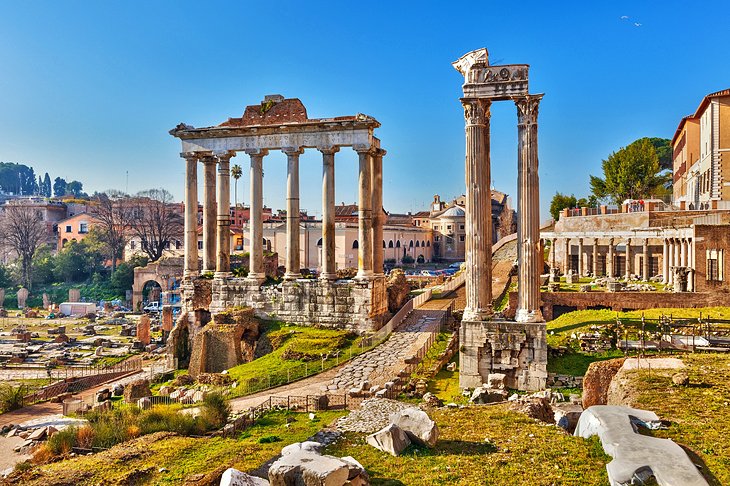
In the summer. and Wed-Sat. 9.00-19.00, nd. i wt. 9.00-13.00; in winter every day. 9.00-15.00; 5000 L. After crossing the street here, you enter the partially excavated remains of the Imperial Forum - there are only piles of broken columns - next to which is the entrance to the main area of the Roman Forum and the Palatine Hill. Not easy there 0 loneliness, because everyone considers it a point of honor to visit these places. For many people, however, these are also the most disappointing monuments and a need for imagination and some historical knowledge, to be able to appreciate their importance.
You will surely see some of the most authentic ruins in Rome here: the neighborhood had been abandoned for so long, that practically nothing has been left intact. The heart of Mediterranean civilization was beating on these roughly two hectares of land - the Forum is a tangible and powerful legacy of the empire, which ruled over much of the world for nearly five centuries, and whose influences echo to this day - in language, in architecture, vocabulary, political systems, even in an aura of romance, which over the last few centuries has been overgrown with its ruins. Already in ancient times, Rome was a very large city, with villa buildings and insulae extending up to the Aurelian walls. The forum was the center of the city, it housed political and religious institutions, shops and stalls, everyone used to meet here. It was like that until the imperial times, when Rome's growing role as a superpower resulted in the construction of additional public squares nearby. The Forum never regained its former glory and began to fall into oblivion. W III w. the fire decimated the buildings; the damage was repaired, but the whole city was on the brink of collapse, and the advent of Christianity only accelerated the process, especially when it comes to pagan temples and institutions. After several barbarian invasions, the center fell into disrepair, the remains were used during the Middle Ages and the Renaissance as building materials in other districts, and the better-preserved fragments were transferred entirely to some church or tower. Excavations in this area began only at the beginning of the 19th century and have been progressing continuously since then: part of the area is closed, as the excavations continue.