 Rome undoubtedly provides many attractions, and you may not need to venture outside the city. However, the Italian capital is often hot and crowded, and the plethora of churches and museums can be boring, so without feeling guilty, you can leave the city steeped in history and explore the area. Two main attractions, which can be seen in one day are indeed ancient Roman monuments, but the access itself allows you to take a break from the hustle and bustle of the city. Located an hour by bus east of Rome, Tivoli is famous for its nearby travertine quarries, a beautiful ancient Roman villa and landscaped gardens and parks. Ostia, located on the other side of the city, close to the sea, is just as easy to reach. It is the main bathing area for Romans (and therefore better avoid them), with a well-preserved Roman port from classical times, which is worth visiting. You have to remember, that there are also many other places in Lazio, like Lake Bracciano and the Etruscan monuments north of Rome, Castelli Romani, Palestrina and Subiaco and sections of the coast to the south, which can be visited during a day trip from Rome, especially when you have a car. Details later in the guide.
Tivoli
Rising from the hill above the plain, Fr. 40 km from Rome TIVOLI has always been a kind of shelter for the inhabitants of the metropolis. In the classical period, Roman dignitaries settled here in their old age; during the Renaissance it was a place of entertainment for the aristocracy, who eagerly built her villas here. Today you hardly know the rich in Tivoli, but the city is still doing great with travertine mining. The valuable limestone is exported all over the world (the quarries are located on both sides of the access road from Rome), and the proceeds of this keep a small old town with souvenirs of a glorious past.
City
Most people start their tour with Villa d'Este (in summer every day. 9.00-19.00, in winter every day. 9.00-16.00; 5000 L) opposite the Largo Garibaldi market. It was the country estate of Cardinal Ippolito d'Este, was established in 1550 r. from the convent rebuilt by Pirro Ligorio and is now crowded with tourists even in the off-season. They come here not so much for the sake of the villa itself (which is an enfilade of the dark ones, peeling halls adorned with mannerist murals), what gardens fall with a series of terraces. They are perhaps the most elaborate gardens in Italy, with a brilliant and almost symmetrical layout, and carefully cared for lawns, shrubs and hedges are accompanied by humorous fountains here and there. The fountains were very inventive for those times (one plays the organ, another one imitates the singing of birds), although today the less eccentric ones attract more attention. In the middle of the gardens is Bernini's Fontana di Bicchierone, one of the simplest and most elegant, and looking as if it came from Gaudi's hand; Rometta, or "Little Rome", on the left, at the end of the garden, it is decorated with replicas of the main Roman edifices and a boat with an obelisk; the best one, however, is the Fontana del Ovato on the other side of the garden, surrounded by statues; you can walk in a fairly damp arcade at the back.
For less money, you can visit Villa Gregoriana within an hour (codz. 9.00-19.00; 1500 L), park with waterfalls, which arose, when in 1831 r. Pope Gregory XVI changed the course of the river, to temporarily drown the city. The villa is less known and less frequented than the d'Este property and does not have such ingenious facilities. Lush and wild vegetation descends to the over 60-meter long ravine. There are two main waterfalls: Granda Cascata further down the property and a small cascade designed by Bemini at the mouth of the ravine. A steep path on the other side leads to the bottom of the canyon and the waterfall, leading next to two arrowheads, where you can listen to the thunder of water overhead in the dark, fanstastically vaulted halls. The path continues to the exit and to large sections of the Temple of Vesta adjacent to the hillside. The temple is now part of the property of a nearby restaurant, but sightseeing is allowed, and the view is among the best in Tivoli and extends to the tall green hills on the other side of town.
Hadrian's Villa
Every summer. 9.00-19.00; in winter every day. 9.00-16.00; 4000 L
Apart from the two villas described above, there's not much to see in the city. However, fifteen minutes walk from the road from Rome (you can ask the Rome-Tivoli bus driver to stop or take the local bus CAT nr 4 z Largo Garibaldi), almost at the foot of the hill, Villa Adriana is located, which highlights the great inventiveness of the Cardinals and Popes of Tiwol. It was probably the largest and most magnificent villa of the Roman Empire, where Emperor Hadrian spent the last years of his life, between 135 a 138 r. n.e. It occupied huge areas, so you need some time to see everything, but don't be in a hurry - if you leave Rome early enough, you can visit all the monuments of Tivoli in one day.
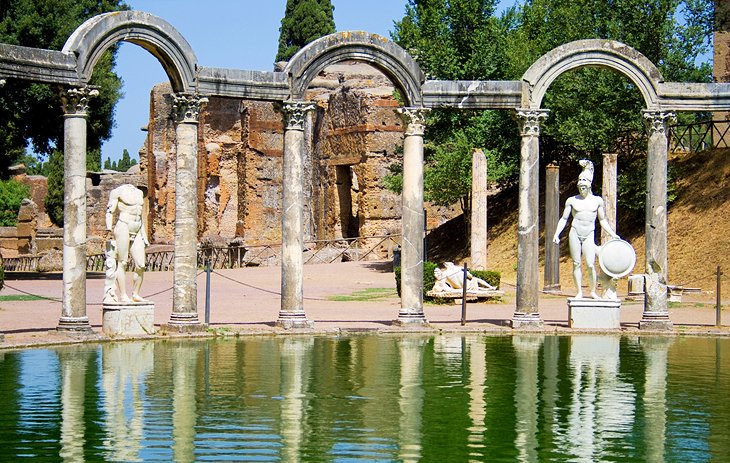
The villa is one of the most relaxing sights in the Roman area, being almost the embodiment of the romantic, civilized ruins. The actual buildings of the imperial palace have survived the worst, but almost all other parts of the complex are clearly recognizable. Hadrian was a great traveler and a great architect, hence the inspiration for some parts of the villa were the buildings, which he had previously seen outside the country. For example, massive Pecile, through which you enter, is a reconstruction of a building in Athens. However, Canopus at the other end of the property is any replica of the Sarapis sanctuary near Alexandria. Along the long, an elegant water channel, sparse columns and statues lead to the Temple of Sarapis at the far end of the property. Finds from almost non-stop excavations are on display in a nearby museum, although the most interesting discoveries found their way back to Rome. Going back towards the entrance, it is worth going to the upper floor of the so-called Pretorio, the former warehouse and the ruins of two thermal baths. There is a fish pond at the back, in which cryptoporticus is sunk (underground corridor) and the remains of the imperial apartments. Neighboring Teatro Marittimi, with an island in the middle of a circular lake, was the place, where Emperor Hadrian probably went to siesta, having confidence, that no one will disturb him.
Practical information
Buses leave Rome to Tivoli every half hour from the west end of via Gaeta, right near Piazza Cinquecento; a return ticket costs money 3400 L, available at the office on the right; time of travel 45 minutes. In Tivoli, buses arrive and depart from the Largo Garibaldi market opposite the AAST office (pn.-sb. 9.00-14.00), who can provide information on the monuments of Tivoli and possible accommodation.