 Sabińskie Hills
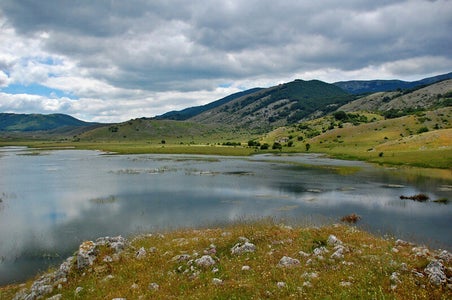
SABIŃ HILLS south of Rieti is a much easier excursion area than the mountains in the east. For an area so close to Rome, tourist traffic is negligible here, due to the lack of large monuments, and also because of communication difficulties. Small towns are connected by secondary roads. The landscape is an advantage of the region, the most beautiful one east of via Salaria around Lago del Turano and Lago del Salto, with the largest center in ROCCA / SINIBALDA. There is a fortified castle surrounded by tall buildings, forested hills. To the north-east of Rocca Sinibalda there is a stretch of barren land, z Mount Núria (1888 m) i Monte Moro (1524 m) in the middle. The area is mainly suitable for excursions and backpacking trips. You can target the wild, unpolluted lake Lago Rascino, especially if you have a tent.
Many towns on the other side of Via Salaria have been doubly damaged, first by migration to Rome, and in recent years, ironically, by richer Romans, who have returned, to buy summer cottages here. Towns are still largely the same as they used to be: small, self-sufficient and compact hilltop villages, but all their charm boils down to varying degrees of medieval character. Undulating landscape, in which they are inscribed, he is moderately pretty. The old Benedictine abbey in FARFA is an undoubted attraction in this not very impressive region, situated 6 km from FARO, amidst a beautiful landscape of olive trees. (From FARO you can take the ACOTRAL bus). The monastery was founded in the 5th century., and then endowed by Charlemagne and for some time belonged to the group of the most powerful abbeys in Europe, with its enormous economic base, merchant fleet, and even with their own army and rights to Aquila, Molise, Viterbo, Spoleto, Tarquinii and Civitavecchia, that is, all of central Italy. However, at the end of the Middle Ages, the decline of the monastery began, and numerous structures erected in the 15th and 16th centuries. obliterated gorgeous, medieval character of the abbey. The monastery church has many treasures, and several 11th-century frescoes have been preserved in the belfry, but the main attraction is the new museum, accumulating the diverse heritage of the abbey, as well as local archaeological finds. The most fascinating is the 6th century Cures pillar. BC. with a Sabine inscription, found at the bottom of the local river in 1982 r. It is the only known and as yet undeciphered monument of the previously ignored Sabine culture.