 Collegiate
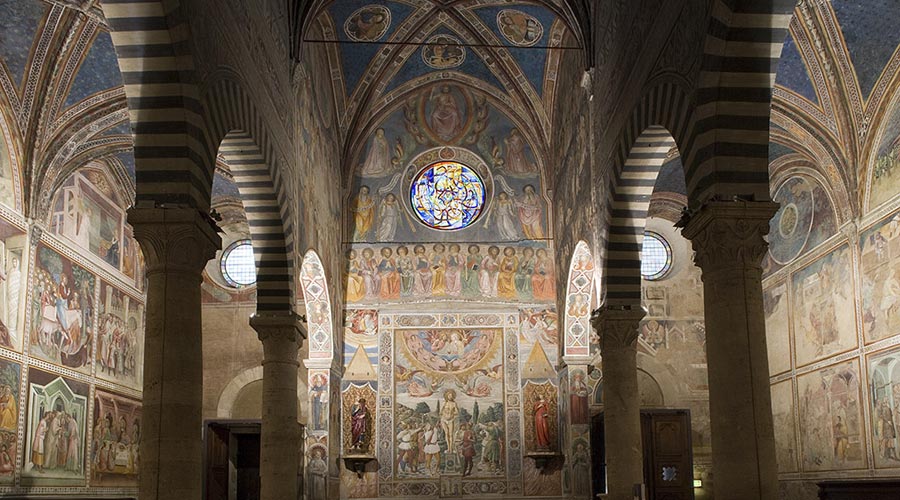
The simplicity of the collegiate façade is deceptive, because behind it hides one of the most densely frescoed churches in Tuscany. You need to take a full pocket of stulirów with you, to see the series of paintings, which fill every available plane. Their brilliant colors are emphasized by the Pisan-Romanesque arcades of marble in black and white stripes. The church is closed from 12.30 do 15.00.
The basic cycles are paintings from the Old (on the left wall) and the New Testament (on the right); in the lanterns at the top, the scenes of Creation were contrasted with birth. Old Testament scenes were completed by Bartolo di Fredi ok. 1367 r.; lots of medieval details in costumes, Classes (Abraham and Lot leading their flocks to Canaan) and interiors (bedroom in Joseph's Dream). These paintings are bizarrely naturalistic—it's hard to find a freak more bizarre than Drunken Noah.: the patriarch exposes himself in alcoholic dullness. The New Testament scenes were started by Bam da Siena (1381) and completed by one of the students after the artist's death, which fell from the scaffolding during operation. The paintings are more Renaissance in concept – there is no characterist for Barthol's taste for genre scenes – and what impresses the most is the individualization of the expression of the eyes in The Betrayal of Judas and Christ Carrying the Cross..
A completely different vision imbues the Final Judgment of Taddea di Bartolo (1393) on the inner wall of the façade. This is one of the most gruesome versions of this topic, including bold depictions of the seven deadly sins, including Bosch-style fantasies about greed and gluttony. Underneath there is an image of St. St. riddled like a sieve. Sebastian by Benozzo Gozzoli, painted in gratitude for the pestilence in 1464 r.
The chapels of the cathedral were rebuilt in the mid-fifteenth century. by Giuliano da Maiano. At that time, San Gimignano commissioned the most important work – a series of frescoes by Domenico Garlandaja for Capella di Santa Fina. It is an exquisite painting, which can be viewed with a general tourist ticket (4000 L) also entitling to access to museums in the city. Shows a local saint, born in 1238 r., which at the age of 10 years was struck by a terrible and incurable disease. She immediately offered herself to God, repented of sins (the most serious of which was probably the reception of oranges from a boy) and spent five years from death— foretold in a vision, which Saint had. Gregory — lying on a board on the floor.
To the left of the cathedral is an arch overlooking the courtyard topped with a statue of Saint Gimignano. The courtyard has a loggia from the front, decorated with the Annunciation of the Garlandaja. Rather anonymous religious and Etruscan museums are located in buildings adjacent to the courtyard, on which in the summer there are often musicians.
Palazzo del Popolo
Visit to Palazzo del Popolo (Tue—Sat. 9.30-12.30 i 15.30-18.30; X-III to 17.30) gives you a chance to climb Torre Grossa, the highest of the existing (50 m) and best preserved from the towers, and at the same time the only one, which you can climb. It is an impressively solid building, with various cellars and gallery, from where there is a wonderful panorama.
In the same building, many rooms were dedicated to the Museo Cirico. The first of them, with frescoes depicting hunting scenes, it is called Dante's Hall — the poet came here in 1300 r. as envoy of Florence, calling for loyalty to the Guelphs. Most of the exhibited paintings are fourteenth-century works, of Sienese origin or inspiration. They were created before San Gimignano entered the orbit of the influence of the Florentine Renaissance.. The most beautiful exhibit in Dante's Hall is Maesta Lippo Memmiego (1317), masterpiece, based on Simone Martini's work in Siena on the same subject. However, the most fascinating paintings in the palace are hidden in a small hall near the stairs. These are frescoes with wedding scenes, tournament, during which the wife rides on the back of her husband, then a common bath and entrance to the double bed. These thematically unique paintings were completed at the beginning of the fourteenth century.. by the Sienese painter Memmo di Filipuccio.
Rest of the city: Saint Augustine
Away from the central squares and via San Giovanni, crowds thin out quickly. Via di Castello, east of Piazza della Cisterna, leads past the Romanesque San Lorenzo in Ponte (one of the few open churches, with dramatic fragments of the fresco The Last Judgment) and adjacent Farmacia Prcindustriale (wt.-nd. 9.30-12.30 i 15.30-18.30). It was part of a medieval hospital, maintained by the city council, and has an interesting exhibition of medicines and medical equipment, as well as an exhibition showing the history of San Gimignano during the plague. Next is Via del Ponte, almost rural road, which winds down between the vineyards to the walls, next to the city well — Fonti — and overlooks the open.
Via San Matteo north of Piazza del Duomo is one of the most magnificent and best preserved streets of the city, with secluded alleys also leading to the walls. The street ends near the gate — Porta San Matteo. Right behind her, in the corner of the walls, there is a large hall church of Sant Agostino (8.00-12.00 i 15.00-19.00; X-1II to 17.00). There are a number of beautiful paintings and chapels, including a heavily damaged cycle of frescoes The Life of the Blessed Virgin Mary bartola di Fredi. However, the biggest attraction is the cycle of seventeen scenes from the Life of St.. Augustine Benozzo Gozzoli (1465), behind the main altar. The saint, who was reluctant to celibacy, was shown while studying grammar at the University of Carthage., specifically, when he is flogged by the teacher (Augustine mentions such punishments in his Confessions.): another scene depicts him on a trip to Milan, where he was to teach philosophy.
Practical details
All three hotels in San Gimignano are expensive, with twos in the area 70000 L. However, you can find cheap accommodation in Ristorante II Pino (via San Matteo 102; 940415) and about twenty private houses, in most of which twos cost 35000-40000 L. A good new youth hostel was also built on via delle Fonti 1 (0577/941991; Reception 7.30-9.30 i 17.00-23.30); membership not required, 12000 L per person including breakfast and shower. Convento di SantAgostino provides the best opportunities, where there are about a dozen beautiful doubles after 30000 L (you need to write or call in advance 0577/940383).
In low season it is very easy to find a room for rent. The full list can be obtained at the tourist office in Piazza del Duomo. From May to September you will save yourself a lot of trouble by using the services of the Uffizio Informazioni Turistiche on via San Giovanni 125 (pn.-sb. 9.30-12.30 i 14.30-19.30, nd. only before noon), which has rooms for a fee 2000 L. The nearest campsite is II Boschetto (0577/940352; reception closed 13.00-15.00 i 20.00-21.00), 3 km down towards Santa Lucia. There are occasional bus connections (500 L), bar and shop; fees are 4000 L per person, 2000 L from the tent.
In bars and restaurants, there is a lot of pay for just using the table – so you should find out in advance, what is the menu. One of the most popular places, a little cheaper than most, to Le Vecchie Mura on via Piandornella (plaque at via San Giovanni), offering inexpensive pizzas and fixed sets. From snacks you can buy pizza by weight at via San Giovanni 38, and on Thursday or Saturday until noon at the market in Piazza del Duomo you can get a variety of food (including rolls with roasted wild boar — cinghiale).
For most visitors, the city landscape is a sufficient attraction, but from June to October in San Gimignano there are a number of small summer festivals. Events include classical music concerts, theatre performances and film screenings in Rocca.
The most common bus connections are from Poggibonsi, where you need to change, coming from (or to) Siena or Florence. Poggibonsi also has a railway station on the Empoli-Siena line. In the western direction there are about five connections a day with Volterra.
Poggibonsi, Colle di Val dElsa i Monteriggioni
POGGIBONSI has little to offer beyond rail connections and political life. The city council of this industrial city – distinguished by its ugliness among its Tuscan neighbours – is considered the reddest in Italy. A stop in Poggibonsi is almost inevitable, if you use public transport. There are bars and cafes, where you can spend time until departure and cheap hotel, but not much to explore.
COLLE DI VAL DELSA, with its old upper town, is much more interesting and also has numerous connections with Florence and Siena and its province. Buses stop at the main square of the lower town, where there are a few modest hotels (the cheapest is Olimpia; •> 0577/921662). To Colle Alta, upper town, you have to climb steeply uphill and there is an atmosphere of a city a bit extinct; main Street, via del Castello, runs along a narrow ridge. Several medieval palaces rise next to it (including one with a tower, at 63, where the architect Arnolfo di Cambio was born), and in the middle of the length the street opens to Piazza del Duomo. In Palazzo Vescovile (you have to ring the doorbell) by the square there are frescoes with hunting scenes by Bartolo di Fredi and a large collection of Sienese paintings. At the further end of the street is Porta Nuova, designed by Renaissance architect Giuliano da Sangallo.
The last possible stop on the way to Siena is the tiny fortress village MONTERIGGIONI, whose towers Dante compared to giants. The most impressive aspects of the fortress are its walls and location: rises high above the Florence-Siena motorway and is visible for many kilometers. On the market is good, although expensive restaurant II Pozzo (nd. evening and Mon. not CZ.).