 REMAINING PART OF THE PALACE
Raphael's Halls and the Sistine Chapel are just a small part of the Vatican. From now on, selectivity is necessary. On the upper floor there are Appartamento Borgia - small, airy rooms with no frills, you'd expect from a papal seat - with a random collection of contemporary religious art, but it is worth seeing the frescoes by Pinturrichio on the ceiling in Salla dei Santi. It is characteristic of an artist, rich in color and detail, the work is dominated by the portrait of Lucrezia Borgia as St.. Catherine.
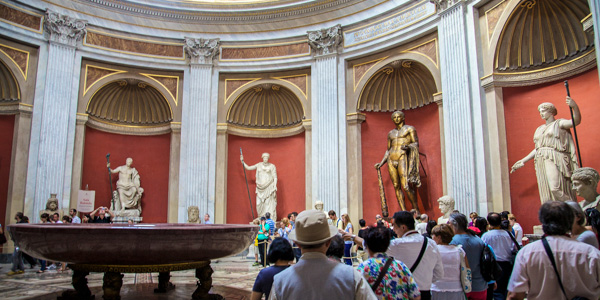
Most of the other museums are located at the opposite end of the Vatican Palace. The best part is the little Museo Pio-Clementino. Some of the finest statues in the Vatican are housed in a small courtyard known as the Cortile di Belvedere, including Apollo Belwederski, an old Roman copy of the original from the 4th century. BC. and the Laocoon Group of the 2nd century. BC. These two statues influenced Renaissance artists more than all the others. Grupa Laokoona, found under the Golden House of Nero in 1506 r. and depicting the treacherous priest Apollo, crushed with his sons by snakes, aspires to be the most famous classical sculpture in the world. Pliny mentioned her, and Byron described the realistically depicted pain as "ennobling".
Museo Chiaramonti and Braccio Nuovo next to Pio-Clementino have many more classical sculptures, but this is already the Vatican in its most overwhelming form: nearly a thousand statues were crowded into two long galleries, so you need a sharp eye, to distinguish grain from chaff.
Better to go straight to the Egyptian Museum (Egyptian museum), founded in the 19th century. by Gregory XVI and Gregorian’ Etruscan Museum (Gregorian Etruscan Museum) on top, where there are sculptures and works of funeral and applied art, harvested in southern Etruria - a good complement to Villa Giulia.
Alternatively, you can skip these museums completely and go straight to the Pinakothek, located in a separate building at the very end of the Vatican's main axis. It has probably the best picture gallery in Rome, with works from the early to late Renaissance. Among the earlier works are paintings by the Crivelli, Lippiego i Giotta, and everyone's attention is drawn to the latter's "Poliptych Stefaneschi", showing, among others. martyrdom of St.. Peter and Paul. You can also see soft, elegantly dressed painters of the Umbrian school, Perugina and Pinturrichia. A separate room is dedicated to Raphael, including, among others. unfinished Transfiguration painted at the end of the artist's life. St. Hieronymus Leonardo in the next room also gives the impression of being unfinished, and it is an outstanding work, where Jerome was depicted as a skinny ascetic. More attention is paid to the Deposition of Christ in Caravaggio's tomb, a work extremely realistic. Exhibited in the same room. Crucifixion and in. Piotr Guido Reni is a successful imitation of Caravaggio's painting method.
Behind the Pinakothek there is a group of museums in modern buildings. At the Museum of Secular Art (Profane Gregorian Museum) there are other classical sculptures, placed on scaffolding yes, so that they can be viewed from all sides. You can find examples of sepulchral art there, including Friesians from the tomb of Hatieri, featuring the cityscapes of ancient Rome and realistic genre scenes. In the adjacent Museo Pio Cristiano there are early Christian sarcophagi, as well as the famous expressive statue of the Good Shepherd from the 3rd century. n.e. And at the Museo Missonario Etnologico, you can see works of art and crafts collected all over the world by Catholic missionaries..