The Tuscan coast is touristically uneven. At its best – in the low season – on the islands of Elba and Giglio can compete with every coastal region of Italy. But driving along the mainland you have the impression of monotony and excessive expansion: hundreds of seedy bathing areas with hotels and campsites, and beaches to the last grain of sand appropriated by the agents of sun umbrellas. On the other hand, in the summer on the islands the most frequently discussed topic is probably the inability to find any accommodation.
The coastal mountains in the north are more optimistic, in the shadow of Alpi Apuane, and the feral peninsula of Monte Argentario in the southern Maremma. For foreign guests, unlike italians, the biggest attractions of the region are located inland. Pisa needs no introduction; it's a little different with Lucca, even though it's elegant, the walled city is unmatched among Tuscan Romanesque centers; and for all, who are interested in the genesis of Michelangelo's sculptures, Carrara marble mines high in the mountains may be of interest.
Pisa
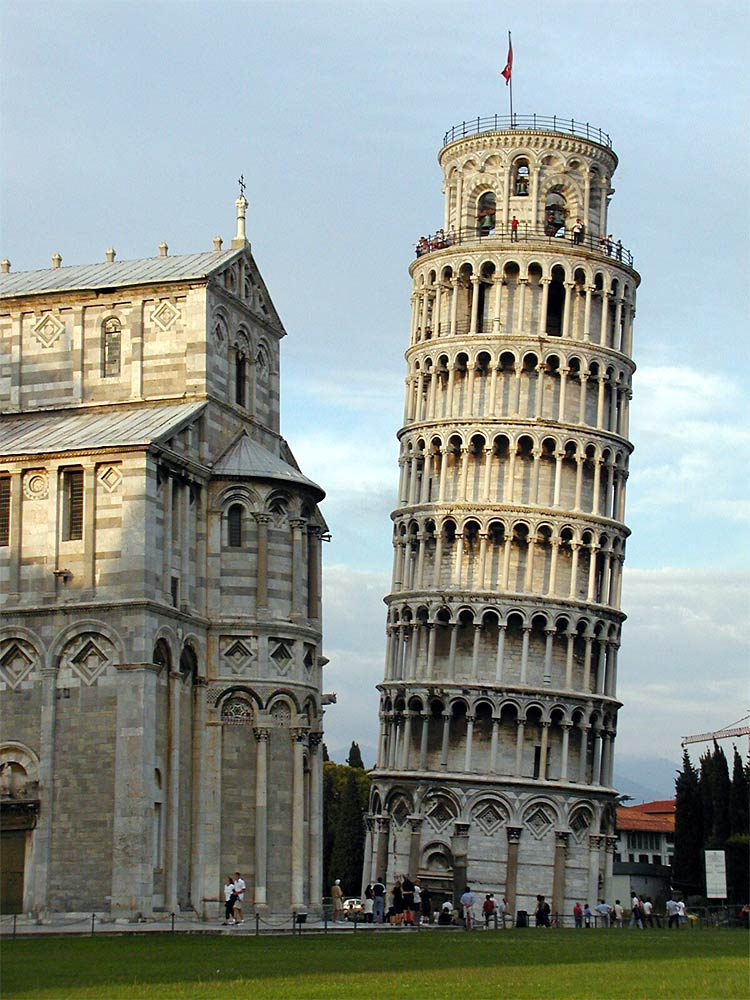
It is impossible to run away from the Leaning Tower in PISA. This medieval bell tower is one of the most famous cultural monuments, yet her beauty comes as a surprise in direct confrontation: the tower rises like a chess figure next to the cathedral and baptistery on the manicured grassland of Campo dei Miracoli - "Fields of Miracles".
All these buildings on Campo, and a dozen churches and palaces scattered around the city, come from the "Golden Age" of Pisa in the twelfth and thirteenth centuries. Then the city, then port, was one of the greatest maritime powers of the Mediterranean. Buildings in the Pisan-Romanesque style with characteristic impressive facades of black and white marble, were decorated with some of the most beautiful Romanesque sculptures in Italy, from the studio of Nicola and Giovanni Pisan.
The peak of political power was reached by Pisa in the second half of the eleventh century.. after a series of victories over the Saracens, whose monks drove out of Corsica, Sardinia and the Balearic Islands, and took their toll even in Sicily. After the defeat in the naval battle with Genoa, St. 1285 r. and the gradual silting up of the port, however, collapsed. From 1405 r. the city was under the rule of Florence and developed intellectual activity as the seat of one of the leading universities of the Renaissance; Galileo taught here, the most famous son of Pisa. In the centuries that followed, the city grew more provincial - and that was what the Shelleys and Byron found it to be, when they settled in the local palaces, assuming the "paradise of exiles", as Shelley put it. Modern Pisa has been brought to life by the airport, industrial suburbs, university and drainage of coastal wetlands.
City
Orientation in Pisa is uncomplicated. By train you arrive in Piazza della Stazione on the southern bank of the Arno, a bus to the nearby Piazza Vittorio Emanuele II or the neighboring Piazza San Antonio. On Campo dei Miracoli you go from here ok. twenty minutes, by Ponte di Mezzo, or it takes five minutes by bus (nr 1) from in front of the railway station; Tickets for city buses can be purchased at the kiosk on the left after leaving the station.
By car, follow the arrows to the municipal car park at Porta Nuova, just west of Campo dei Miracoli. From the airport (Galileo Galilei) take the train to Florence (40 minutes past every hour), who has po 5 minutes first stop in Pisa.
Field of Miracles
The impression when entering the "Field of Miracles" is enormous. Nowhere in Italy are the main city buildings - the cathedral, baptistery and belfry - are not situated with such precision and refinement. There is also nowhere to be found in the curve of the tower that can compare with the Pisa tower; they are indeed different (for example two in Bologna), but they give way to the effectiveness here.
Probably the weirdest thing about the Leaning Tower is this, that she was leaning to one side from the very beginning. Construction began in 1173 r. As a result of the collapse of the ground, the foundations moved, when three of the eight storeys were built; for the next 180 years, subsequent architects tried to remove the deflection, until finally, Ok. 1350 r., Tomasso di Andrea da Pontedera reconciled with him and completed the tower. Eight centuries later, it is judged, that the deviation has reached its limits: Exceeded 4.5 meter and increases by a millimeter every year. In October 1989 r. Ministry of Public Works (in Rome) considered the tower to be a threat to safety and suggested closing it to tourists, but the Pisans refused, which is not surprising given the ticket revenue of one million pounds a year. So for now, you can still pay 4000 L for admission (codz. 9.00-19.00, winter 9.00-17.00), stroll through the dizzying open galleries and climb to the top, from where Galileo dropped metal balls of different weights, to prove his theory of the constancy of earthly attraction.
Cathedral (codz. 9.00-19.00; winter 7.45-12.45 i 15.00-17.00) was built at a similar time. Original porch, Portale di San Ranieri, stands opposite the tower; visible there scenes from the Life of Christ, cast in bronze ok. 1180 r. by Bonnano Pisana, show strong Greek and Roman influences. The massive middle door of the main façade from Giambologna's studio is a more ambitious work, with lots of Renaissance details. However, they can be considered a small thing in comparison to the enormous scale of the main facade. Its delicate balance of black and white marble, several levels of arcades and geometric motifs as well as the careful layout of light and shadow set the pattern for the highly characteristic Pisan variety of Romanism.
Black and white marble was also used in the interior, and the long arcades give the church an almost oriental character - in a spirit that does not differ too much from, for example, the Great Mosque in Cordoba. The interior has been re-equipped, and some chapels were rebuilt after the fire of 1596 r., so most of the paintings and sculptures are from the renaissance or later periods, earlier is Christ in the majesty of Cimabue, located in the apse. The famous gothic pulpit, carved by Giovanni Pisano, was put in storage after the fire, because gothic is out of fashion, and it was rediscovered only in 1926 r. Latin inscription around the base states, that Giovanni had "the art of pure sculpture."… and from under its chisel, ugly or vulgar things would not come out, even if he wanted to. " It is definitely a show of virtuosity, inspired by classical sculpture, but going on, towards a more dramatic and detailed story (take centennial coins for lighting). And finally, the cathedral has its own scientific legend. The news goes, that great bronze incense, which he flaunts at the censing of the nave, inspired Galileo to develop a theory of pendulum motion.
The third building in the Miracoli complex, colise baptistery (open at the same hours as the cathedral), is a bit of a bizarre mixture of Romanesque style (three levels of arcades) and gothic (elongated dome). The overall effect resembles a spaceship beached by the waves. The building comes from the same period as the neighboring one and has been decorated with statues (currently displayed inside) by Giovanni Pisano and his father Nicola. The height of the interior and the wonderful acoustics are striking - which is demonstrated by the curator from time to time. In the middle there is a baptismal font in an exotic pizza-Romanesque style. It is the work of Guido da Como (1246), and it was placed on stone steps to facilitate immersion. On the left there is a pulpit by Pisan, carved in 1260 r. It was Nicola's first major commission, which introduced the Gothic style to Italian sculpture.
On the north side of Campo is Camposanto (codz. Summer 9.009-19.00; winter 9.00-17.00;2000 L), cemetery surrounded by cloisters, built at the end of the 13th century. The walls and some of the chapels are frescoed, including scenes from the Old Testaments of Benozzo Gozzoli (to the left of the entrance) and fascinating images of the Theological Cosmograph (on the north wall). However, the most important cycle is the 14th-century Triumph of Death in the Ammanati Chapel: a merciless catalog of atrocities, painted directly after the Black Death. There are also collections of paintings, several sculptures (some Pisanów chisels) and numerous Roman sarcophagi – the original source of inspiration for Nicola Pisano.
Huge selection of statues, Church vestments and paintings from the cathedral and baptistery can be seen in the Museo dell'Opera del Duomo (codz. Summer 9.00-19.30; winter 9.00-17.00; 4000 L) in the southeast corner of Campo. These enormous collections include images of all members of the Pisano family - many sculptures are still covered with polychrome - and in room no. 13 here are examples of exquisite marquetry, that is, widely practiced here in the 15th century. inlay art in wood.
And finally, on the southern edge of Campo, behind stalls with kitschy souvenirs, it houses the Museo delle Sinopie (codz. Summer 9.00-19.00; winter 9.00-17.00; 2000 L). It is new, well-organized museum created especially for sinopia - reddish-brown drawings made under the frescoes and transferred from Camposanto. Only for professionals.