 The area west of Montepulciano is best explored on foot. Pienza is located just about 11 km on the old road through Monticchiello, and the trail from Pienza runs south to the medieval baths of Bagno Vignoni. If you are addicted to buses, who have a dead period here in the morning, undoubtedly worth it, so that you can walk at least one of these routes. MONTICCHIELLO in itself is an attraction: surrounded by walls, with a sloping watchtower and with Pieve (key in the house and next door), housing 14th-century frescoes and the plaque Madonna by Pietro Lorenzetti.
Pienza
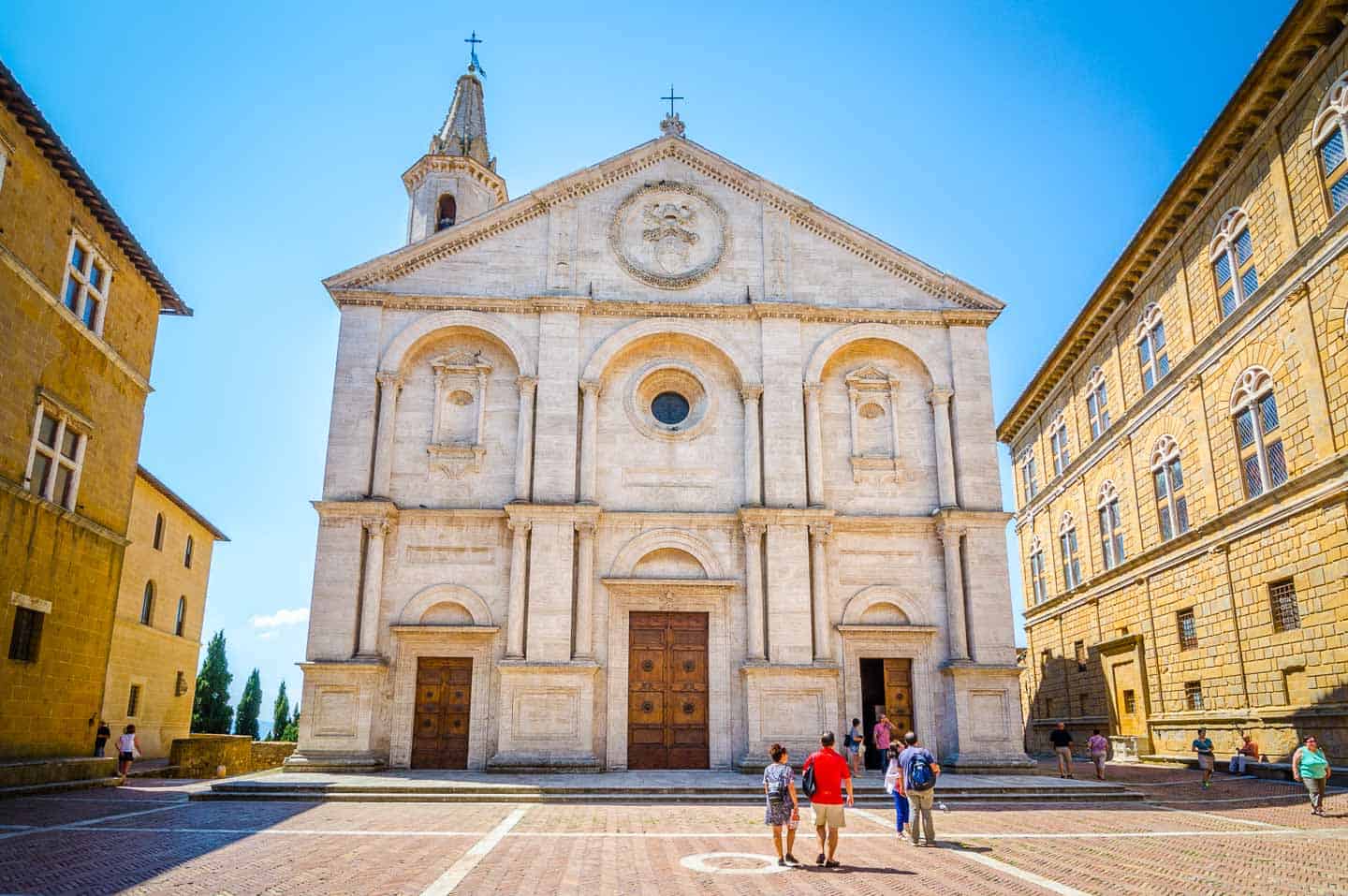
PIENZA is a complete Renaissance creation and was built by Pope Pius II as a utopian "New Town" - a manifestation of considerable vanity. Previously, there was a small village of Cortignano here, in which the Pope was born to a family of outlaws from Siena. The expansion began a year after Pius was elected; all the larger buildings were erected by the architect Bernardo Rosselino under the direction of Alberti. The costs were astronomical, but, surprisingly, the cathedral, papal and bishops' palaces, and the center . the city was completed in just three years.
After the consecration of St. 1462 r. Pius issued a bull, setting the new name of the city j (in his own honor) and reserving, that the cathedral and palaces must not be changed | the smallest detail. Two years before his death, he also established his papal court here. Of Pius II's successors, only Pius III, his nephew, he had any interest in Pienza. City, which was supposed to take the whole hill, it never went beyond a couple of blocks on each side of the Corso, and the number of people (today 2500) puts them in a row of medium-sized villages. At present, there is an atmosphere of emptiness and artificiality here: it looks like a natural theater scene, used by Zefirelli in the film Romeo and Juliet.
There is no difficulty with orientation in the field. Dear, buses and cars descend in Piazza Dante, right behind the main entrance gate, It leads to the Murello, and the Corso leads from here to the market designed by Rosselin, Pius II Square. There is a cathedral next to it, Piccolomini Palace (papal palace), Bishop's Palace, Public Palace oraz czwarty (corner) palace, built by one of the most ambitious Vatican followers of Pius - Cardinal Borgia, the future Pope Alexander VI. The town hall in the square is a typical medieval nod to Florence, but otherwise the square is completely renaissance in concept.
Cathedral (13.00-15.00 not CZ.) has one of the earliest Renaissance facades in Tuscany; and the interior, commissioned by Pius, is modeled on the German hall churches, which the Pope saw on his travels, and remains gothic in essence. The chapels house a fairly colorless series of Sienese altar paintings, commissioned by the Pope and his architect from the most important painters of the era — Giovanni di Paolo, Matteo di Giovanni, Vecchietty and Sano di Floor. Not known, how long the whole building will survive, because due to the small area of the plot, Rosselino had to build on sandstone and clay. Already before the completion of the building, a crack appeared, and after the earthquake in our century it was necessary to constantly increase the number of buttresses and trusses.
Residence of Pius, Piccolomini Palace, was modeled on the Florentine Palazzo Rucellai in Florence, with an ingenious addition in the form of a three-level loggia at the rear. You can enter the courtyard at any time of the day. Apartments (wt.-nd. 10.00-12.30 i 16.00-19.00; 2500 L) include a bedroom, the library and other rooms of Pius II, with collections of weapons and medals. Further mementos of the Pope (including embroidered quilt and Siena blackboard paintings, can be viewed across the square at the Museo Civico (śr.-nd. 10.00-13.00 i 16.00-19.00).
Two earlier churches have survived from Cortignano. St.. Francis, adjacent to Palazzo Piccolomini, it has 14th-century frescoes, cloisters and a panoramic snack bar above the Piccolomini gardens. Below, ten minutes walk west, there is a Romanesque Pieve, in which the future Pius II was baptized. This bizarre structure with a cylindrical tower is decorated with a portal with carvings of knights, rub in the acid.
Practical details
Pienza is an almost extinct city, therefore it is best to come here on a trip from Montepulciano. If you want to stay overnight, w Dal Falco Restaurant (0578/748551) on Piazza Dante there are rooms after that 40 000 L. When it comes to buying provisions, it makes the head ache from the sanctuary. A town at the heart of a peccorino sheep cheese-producing region is in a frenzy of "natural food", so it is full of various grocery stores. At Birreria Sperone Nudo in the center you can get inexpensive beer and crostini, and there are two restaurants in Piazza Dante.
San Quirico d’0rcia i Bagno Vignoni
SAN QUIRICO D’ORCIA, extensive, partially walled town, it lies at the intersection of the Siena-Bolsena road with side roads, and overlooks the valleys of Orcia and Asso. It is quiet and quite worn-out. It has a couple of bars and an extremely beautiful Romanesque collegiate church, with a delicate triptych of Sano di Piętro Brush. There is also a small hotel here, The Patrizia (•0577/897715), deuce from 28000 L.
Vignoni bathroom
Six kilometers southwest of San Quirico lies the tiny village of BAGNO VIGNONI - just a handful of buildings around the market square. However, this square is one of the unforgettable monuments of Tuscany. There is an arcaded piscina from the Renaissance period, built by the Medici, who, as did Catherine of Siena, they came to Vignoni for sulfate treatments. Hot springs continue to beat in the baths (they were an excellent set design for Tarkovsky's film Nostalgia), but to plunge into their waters today you can only in a modern building at the back.
South of the village, along the road through Monte Ammiata to Saturnia (look down) the land of sulphate springs stretches. If you need a stopover, there are two hotels in Vignoni, ranked among the strangest accommodation places in the whole province. Cheaper is La Terme (0577/887150), with twos from 48 000 L.