 North to San Frediano and Anfiteatro
North of San Michele via Fililungo runs through Lucca's richest shopping district, next to Torre delle Oro (city clock tower), beautiful Caffe di Simo (nr 58) and crosses the chessboard of the streets overlooking Piazza San Frediano, where sometimes there is a flower market.
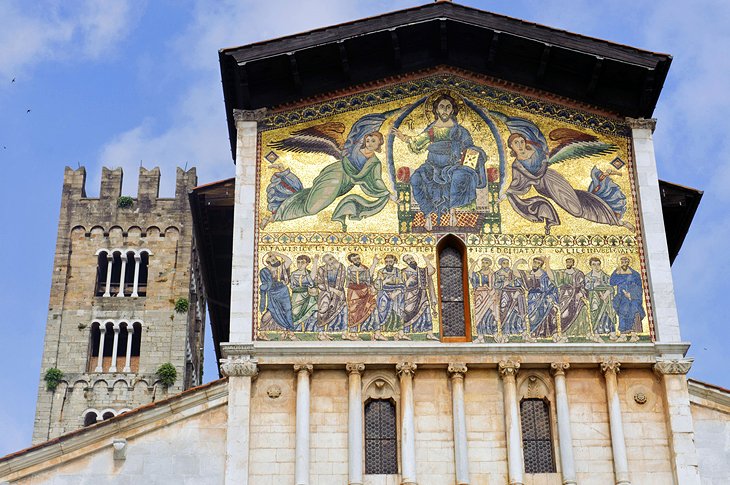
The Basilica of San Frediano is also Romanesque—but its façade is different from that of San Michele and the Cathedral. Instead of multi-level loggias, they are decorated with a brilliant
Thirteenth-century mosaic showing Christ in majesty, with the apostles gathered at the bottom. The interior meets the expectations aroused by the façade: hall basilica, gently lit, with subtly varied columns and capitals contains a number of magnificent works of art. One of them is the baptismal font, carved with Romanesque scenes depicting Moses, The Good Shepherd and the Apostles; and on the back there is a ceramic Annunciation of Andrea della Robbia. Equally beautiful Gothic sculptures can be admired in the altar of Jacopo della Quercia and the peacock tombstones in the Trent Chapel (fourth on the right). In turn, in the second chapel from the left side aisle, you can find the most beautiful frescoes in the city: 16th-century scenes illustrating the Arrival of Yolte Santo (see "Cathedral"), Cuda San Frediano (saving the city from flooding by the Serchio River) and Life of St.. Augustus by Amico Aspertini.
Nearby, at via degli Asili 33, now Palazzo Pfanner (IV-IX wt. -nd. 10.00-17.00). The palace houses a collection of 18th and 19th century costumes - only for hobbyists. However, the loggia and the statuesque gardens are exquisite; they also look beautiful from embankments.
It is worth seeing from the walls and directly visiting the amazing Piazza Anfiteatro - a circle of medieval buildings, the foundations of which are the arches of the Roman amphitheater. The streets around this square are among the oldest and most atmospheric in the city, with several antique and artisan shops and some attractive restaurants.
East of the city: Guinigi Tower and Museum
The strangest element of the city's silhouette is undoubtedly Casa Guinigi, near Piazza Anfiteatro in the south-east direction. It is the 15th-century residence of one of the most important families in Lucca. It has the form of a battlemented tower topped with rock oaks, whose roots pierced the ceiling of the room on the top floor. The tower has been restored and offers some of the best views of the city (IV-IX 9.00-19.00; X-III 10.00-17.00; 3000 L).
Santa Maria Forisportam ("Behind the walls") two blocks to the south it marks the range of the Roman and medieval cities, before the current embankments were built. The church has another classically Lucca façade – also unfinished here. Via del Fosso to the east, with shallow channel, cuts off the eastern part of the city from the rest. In the middle of the length of the street, the canal flows for some time underground, under the square of the church of St.. Francis, with its rosette and striking simple façade. In the courtyard of the adjacent monastery are fourteenth-century frescoes. Behind the Church of St.. Francis across the street is the fifteenth-century Villa Guinigi, built in addition to the family's seat in the medieval old town. Today it houses an important museum of art and sculpture (Tue-Sun; IV-IX 9.00-19.00; X-III 10.00-16.00; 3000 L). The collection includes a lot of beautiful Romanesque sculptures collected from the city and province, as well as some nice works of the master of the cathedral, Mattea Civitali.
Practical details
Lucca is an excellent base for exploring north-western Tuscany, because to Pisa, to the coast and to Alpi Apuane you can go quite a short bus. However, almost at any time of the year there are problems with finding accommodation.
Hotels
A dozen or so one- and two-star hotels in the city are often occupied by students or locals, and generally need to call several, before there is a place. The best strategy is to call in advance – or go immediately upon arrival – to the accommodation service office in Agenzia Civ-Ex in via Vittorio Veneto 28, departing from Piazza Napoleone (0583/56741).
If you look around for yourself, the cheapest hotels inside the walls are Albergo Cinzia, via della Dogana 9, near the cathedral (0583/41323) and Albergo l'Orologio, via San Pierino 7, near San Paolino (0583/53419); doubles in both from 28 000 L. A bit more expensive, with twos from 40000 L, are Albergo Diana, via del Molinetto 11 (*0583/42202) and Hotel Rex in the square of the train station (0583/47615); in turn, from approx. 50000 L costs two in the pleasantly situated Albergo di Poggio, via del Poggio (058365421) i Pension Ilaria, via del Fosso 20 (0583/47558).
Two hotels, in which it is a bit easier to find a place, are located two blocks west of Porta Elisa: Melecchi hotel (0583/950234) i Albergo Stipino (0583/950317), via Romana 37 i 95, deuce from 35000 L.
Also outside the walls, towards the north, is a youth hostel (0583/953686): exit the city via Porta Santa Maria, turn right at the roundabout onto viale Batoni, then the first left viale Civitali and the first right via del Brennero — you will find the hostel on the left. It is open from 1 March to 15 October; reception 18.00-23.00; midnight curfew; 8000 L per person with breakfast.
Gastronomy and festivals
As a culinary center, Lucca is teeming with delicacies, and restaurants are also front branded. The best are devilishly expensive as usual — the II Buca di Sant'Antonio on via della Cervia is ranked among the best in all of Italy. And speaking a little more realistically, We recommend: Trattoria da Leo, via Tagrimi 1, near Piazza del Salvatore (closed. Sb.); Trattoria da Giulio, via San Tommaso 29, next to Palazzo Mansi (closed. nd. and Pn.); Trattoria da Guido, via Battisti 28 and Ristorante Sergio, via S Croce 44 (closed. pn. afternoon and Tue.). In all of them you can compose a full meal for 12 000-20 000 L. Excellent pizza by weight you can get at Pizzeria Castagnacci, Piazza San Michele 25 (closed. Nd.); for a full meal with pizza and a good beer go to Pizzeria Queens (via Prices 13).
Entertainment focuses on classical music and dance. In the summer there are special concerts and events that are part of the Festival di Marlia (w Villa Reale, 8 km towards Pistoia), and in September, the spotlight shifts back to the city with the advent of Settembre Lucchese. During both festivals, at least one opera by Puccini is staged, in September in the intimate, the four-story Teatro Comunale in Piazza del Giglio. Details at the tourist office. An antiques market takes place on the third weekend of each month in Piazza San Martino.