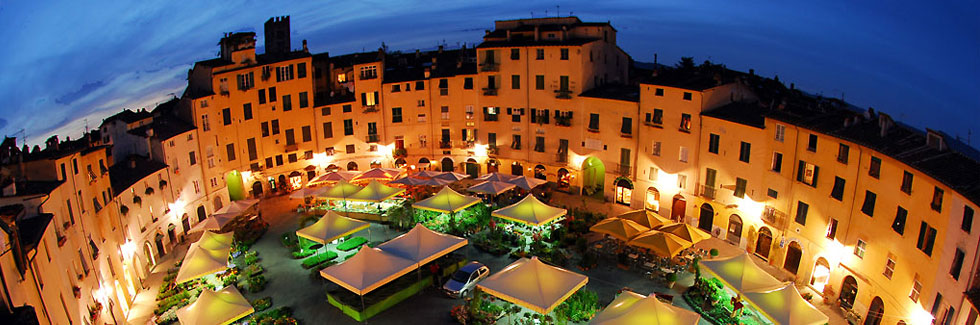
 Lucca (Lucca)
LUCCA is one of the most graceful provincial centers. It is located inside thick Renaissance walls, surrounded by gardens and huge bastions, and has almost entirely medieval, very regular street layout. The buildings consist of palaces and several towers — one topped with a rock oak — and the street sometimes opens to a square., invariably limited by beautifully decorated Romanesque facades. Can not say, so that the city is forgotten, but the number of tourists so far is not excessive.
Lucca lies at the heart of one of the richest agricultural regions in Italy, famous mainly for the quality of its olive oil and has been in abundance since Roman times. The peak of its splendor, however, fell on the period from the 11th to the 14th centuries, when the silk trade brought wealth and temporary political power to the city. After a short time, but the intense military campaign of 1314 r. Lucca lost its independence to Pisa for the first time, and then, under the leadership of the eminent adventurer Castruccio Castracani, she herself created an empire in western Tuscany.. Pisa and Pistoia fell before her, and if it were not for castracani's untimely death, Lucca would probably also conquer Florence. In the following centuries, the city was basically independent, until it fell into the hands of Napoleon, Bourbons and, just before the reunification of Italy, Grand Duchy of Tuscany.
City
The most pleasant way to orient yourself in the area is to walk along the wide road running along the top of the walls. They go on for almost 4 km. They were built in the 16th century. not for show - together with the moats and embankments, they constituted a powerful defensive complex - and only the Bourbon ruler Maria Luiza transformed them into the present garden layout. The last time they played a defensive role during the reign of their predecessor Maria Luisa, Napoleon's sister Eliza Baciocchi, when they prevented the city from being flooded by the waters of the Serchio River, which has risen from the shores.
You get off the bus just outside the western section of the walls, in Piazza Verdi; the railway station adjoins the southern part of the walls from the outside. Piazza Napoleone can be considered the city center, a large area demolished by the Bourbons for their Palazzo Ducale seat. Via Fililungo - "thread" - leads north through the heart of the medieval city and near the EPT in Piazza Guidiccioni. Along the Fililungo, the passeggiata goes all the way to the elegant Piazza del Giglio (adjacent to Piazza Napoleone).
To explore the city, it is worth renting a bicycle, the main means of transport in Lucca. The rental is operated by APT near Porta San Donato (IV-IX 10.00-19.00; 6000 L per day).
Cathedral (Duomo), San Michele and the center
You have to take a good look, to get an idea, why Duomo San Martino (closed. 15.30-18.30) makes strange impressions. The city cathedral has a decidedly asymmetrical façade – the arcade and loggias on the right are shortened due to the presence of a belfry. The building is unfinished, because there is no last, a loggia topped with turrets, and the bell tower itself looks temporary, because in the upper floors the brick suddenly turns into stone. Despite this, the cathedral gives style to the churches of Lucca, with its fluid and sophisticated version of Pisan-Romanesque architecture. As in Pisa, the decorations were partly sculpted by Nicola Pisano — his bas-reliefs on the portico include the Entombment and the Homage to the Magi; and The Life of St. Martin Between the Doors is a masterpiece of the architect of the façade, Guidetto da Como (1210).
Unfortunately, in recent years, these sculptures have been covered for conservation., like almost all major monuments of the hall interior. They include paintings by Fra Bartolomeo, Tintoretta (last Supper), garland (Sacred Conver-sation), the main altar of Filippina Pippi and the Tombstone of Ilaria del Caretto carved in 1405 r. przez Jacopo della Quercia.
There are more opportunities to admire the work of the greatest sculptor in Lucca, Matteo Cmtaliego (1435-1501), represented here by two baptismal fonts, pulpits and a number of tombstones. His greatest work is Tempietto (in the northern aisle), carved to store the city's most famous and profitable relic, Holy Face (Holy Face). legend says, that this "true image" of Christ voluntarily came to Lucca from the Holy Land, first by boat, and then a cart drawn by oxen: a story remarkably similar to the church tale of the bones of St.. James in Santiago del Compostella, Spain. Just like in Santiago, the image has become a destination for international pilgrimages - at the same time giving great power to the local church. Perhaps this is not the case, that the relic appeared in the city during the bishopric of Anselmo da Baggio, who later became pope.
Going northwest from the cathedral, crossing Via Fililungo or north of Piazza Napoleone, you reach the square surrounding San Michele in Foro. This church in many ways seems to be more suitable for a cathedral. It is also incomplete, but this time the facade was built, before the money ran out to get the rest of the building up to its height. The effect is wonderful, upper loggias (and rosettes on the back) they are only a screen, crowned with the figure of an archangel. In the rush of eccentricity – imitated in many other churches of the city – each of the columns of the loggia has a different character: some are spiral, some carved or in colourful stripes. The interior is relatively unsophisticated, although there is a beautiful terracotta of Andrea della Robbia and a painting depicting Saints Jerome, Sebastian, Roch and Helena by Filippin Lippi.
Opposite San Michele in via di Poggio 30 Giacomo Puccini was born; his father and grandfather were organists in the church. In their house, Casa di Puccini (Tue-Sun; IV-IX 10.00-18.00; X-III 10.00-16.00), houses a new music school and a small museum, with Steinway piano, on which Giacomo composed Turandot. There are also original scores and photos from premieres. Admission is free, and school students are on duty as guides and release records.
A few blocks to the west rises San Paolino, where Puccini got his first job as organist. Church, rebuilt during the Renaissance, is dedicated to the first bishop and patron of Lucca, whose remains rest behind the main altar. At the end of the street, on via Galii Tassi, there is the 17th-century Palazzo Mansi. housing the Pinacoteca Nazionale (wt.-sb. 9.00-19.00, nd. and Mon. 14.00-19.00). The collection of paintings is uninteresting, but the palace itself has a historic value - overloaded with Rococo, reaching the pinnacle of exuberance in generously gilded marriage apartments.