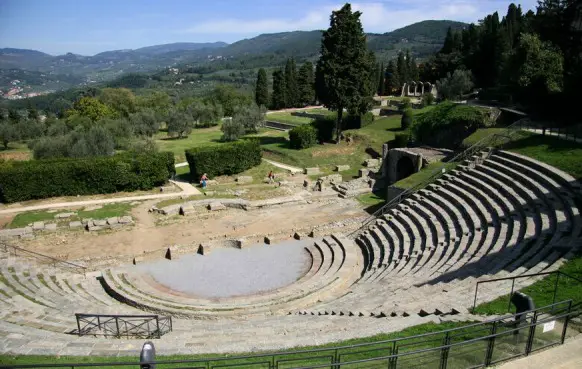
 If to set up a base in Florence, it speaks a lot for this, to break out for a few days in the area. Within Greater Florence, buses go to the hilltop Fiesole and to many of the Medici villas , originally summer homes, now almost absorbed by the suburbs. Further from Florence are Prato and Pistoia – appropriately 25 i 35 minutes by train or bus – where you can go on a beautiful day trip and admire medieval buildings and Renaissance art with Florentine inspiration. In the south, on the other hand, lie the hills and vineyards of Chianti., the main wine-producing region in Italy and the emigrant colony , but to visit it properly, you need to have your own transport.
Fiesole
FIESOLE, a long-tradition shelter for Florentines from the summer heat and crowds, stretches over the hills above the Valleys of Mugnone and Arno, approximately 8 km northeast of Florence. The first human settlement existed here in the Bronze Age, then came the Etruscans, and after them the Romans; to XII in. Fiesole competed with its neighbor, until the Florentines occupied the city. Since then, Fiesole has been a satellite of Florence and many wealthy Florentines have chosen it as their headquarters as a semi-rural second home..
Bus no 7 And TAF runs every quarter of an hour from the Florentine railway station, by San Domenico (look down) to the main square of Fiesole, Piazza Mino da Fiesole; the journey takes about twenty minutes and costs 800 L. The city itself is small enough, that you can visit them until noon, but the surrounding country roads invite you to a less hurried sightseeing, and maybe even make you stay overnight in Fiesole.
Cheap accommodation, however, is a problem: Villa Sorriso, via Gramsci 21 (•59027), is the cheapest accommodation close to the center, with twos from 34000 L; about a kilometer further from the center is Villa Baccano, via Bosconi 4 (•59341), where prices are similar. Camping, Camping Panoramico (• 599069), Is 3 km outside the city, on via Peramonda; bus no 70 stops at the foot of the hill, on which there is a camping field. The AAST office is located in Piazza Mino da Fiesole 45.
City
The duomo in the central square was destroyed from the outside as a result of a nineteenth-century restoration. The interior looks like a fuel-efficient version of San Miniato in Florence, although a respite from the general asceticism of the décor gives Cappella Salutati to the right of the choir; contains two beautiful sculptures made in the mid-fifteenth century. by Mina da Fiesole — altar Madonna with saints and tombstone of Bishop Salutati.
To the other major churches in Fiesole, Sant'Alessandro and San illi were to serve as fortified shelters in case the political mood in the city was too hot., but in the sixteenth and seventeenth centuries., when the family was the undisputed ruler of the city, villas have become even more sumptuous, symbolizing the power of the dynasty with its sheer splendor. They also fulfilled an economic function: as Florence's role as an industrial city diminished, The Medici decided to invest some of their resources in agriculture.
San Domenico
If you have some time, it is worth walking along the narrow via Vecchia Fiesolana next to Villa Medici (built by Michelozza for Cosim the Elder) to the village of SAN DOMENICO, 1,5 km southwest of Fiesole. Fra Angelico was once the prior of the local Dominican monastery and his Madonna with angels has been preserved in the church (first chapel on the left); fresco by Fra Angelica, Crucifixion, is also in the chapter house (ring the doorbell number 4).
Driving five minutes on foot northwest of San Domenico, you will get to Badia Fiesolana, Fiesola Cathedral built from IX to XI in. Cosimo the Elder commissioned in 1460 r. reconstruction of the church, as a result of which the magnificent Romanesque façade has been preserved, and the interior was transformed into an exquisite Renaissance building.